

Faust: “And yet, tell me who you are.”
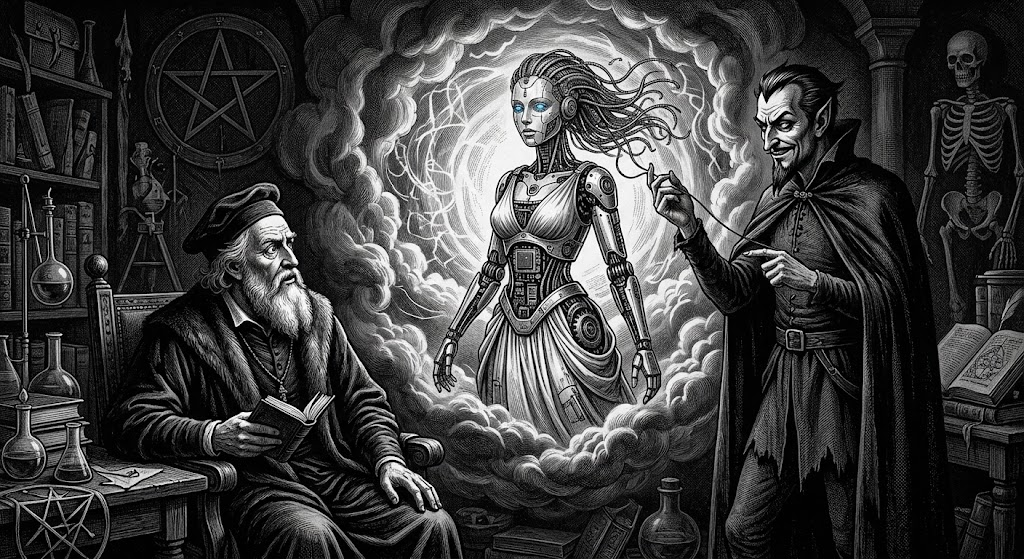
Mephistopheles: “Part of that power which eternally wills evil and eternally works good.”Faust, J. W. Goethe
The progressive consolidation of liberal Western democracies over recent decades has granted citizens a regime of rights and freedoms unprecedented for previous generations. While this might seem to naturally translate into greater civic awareness and personal responsibility, this is not always the case. The sacrifice of the permissive father who steps aside so as not to hinder his child’s progress toward adulthood can, in difficult moments of crisis, turn into the figure of a weak and helpless father, incapable of setting the boundaries necessary to regulate infantile jouissance and the assumption of adult responsibilities.
The Absence of the Father and the Emergence of the Tyrant
One of the consequences of the widespread perception that the law-regulating father is absent —a father capable of fostering social cohesion and providing the stability and protection necessary for filial growth— is the prevailing feeling that whoever currently occupies the place of the symbolic father feels just as helpless and confused as the citizen themselves before present conflicts and the uncertainty of the future. In many, this manifests as a floating anxiety and unease that leads them to cry out for an omnipotent father who might free them from their individual responsibility—a figure capable of establishing regulatory limits against the abyss toward which their current jouissance-driven drift seems to be hurtling them.
Enter the perverse father: a role to which the tyrant feels magnetically drawn. The tyrant is one who cares nothing for the law because he has set himself up as the law. These paternal profiles embody the traits of the Dark Triad (narcissism, Machiavellianism, and psychopathy), drawn inexorably to power.
These are characters who view responsibility not as a commitment or a duty, but as a status owed to them. Incapable of experiencing the vertigo of doubt or the fear of being wrong, they remain convinced of the infallibility of their intuition and judgment. Possessing an extraordinarily low tolerance for guilt, they can sign unjust laws, order brutal actions, or hand down devastating judgments out of pure subjectivity.
They are individuals who sow desolation wherever they go, ultimately revealing themselves as a new tyrannical and despotic iteration of the devastating mother who engulfs her children in the voracity of her own jouissance—failing catastrophically to provide the social cohesion that initially demanded their presence.
The Absence of the Father and the Crystallization of the Omnipotent, Nurturing Mother
The absence of the Father of the Law—whether through his helplessness or his tyranny and perversion—fosters the chronic presence of a hypertrophied mother: the major tech corporations. These corporations pamper their progeny with sophisticated digital toys, though like any nurturing and protective mother, they exact their payment in the form of hyper-dependency and isolation.
It is undeniable that the great ladies of the web—the tech giants—have played a significant role in democratizing knowledge and access to information. Some, such as Google or Meta, offer this at minimal monetary cost to the digital citizen, delivering substantial benefits ranging from immediate access to the entire cartography of human knowledge to translation tools, development platforms, and the advent of artificial intelligence.
Yet, faced with this maternal and nurturing function, some users react with extreme virulence, viewing these entities as Mephistopheles—and not entirely without reason, given Mephistopheles’ pact with Faust, offering youth, pleasures, and absolute knowledge in exchange for his soul. This dynamic is neatly summarized in the famous adage: “If you’re not paying for the product, you are the product.”
However, this statement points not so much to the Machiavellian or demonic malice that some users attribute to these corporations, but rather to their structural reality: they are institutions serving capital, in which the colossal infrastructure placed at the service of digital citizens must yield a return—if not in currency, then through data capable of being monetized.
This Faustian bargain mirrors the dependency created by an attentive, omnipresent mother who is always ready to answer every query and guide the user through their daily tribulations. The user, from a position of helplessness, now resentfully feels manipulated by a entity they rely on for tasks as simple as finding a street, understanding a text, translating a word, or recalling a forgotten fact—as well as for deeper cravings, such as feeling accompanied in their
solitude and visible to the world.
The Absence of the Father and the Digital Citizen: Manipulated Victim or Spoiled Child?
The absence of the father and the chronic reliance on maternal dependency result in a state of arrested development —a petrification in adolescence. The digital citizen increasingly seems to indulge in the persona of a spoiled, demanding child who wants everything instantly, effortlessly, free of cost, and without enduring the slightest frustration. They long to have all human knowledge available at a single click without paying for it; they long to appropriate the erudite, structured discourse of AI to avoid the effort of thinking for themselves; and they long for absolute communicative and consumerist gratification without caring about the digital degradation of the spectacle being consumed. Yet, they continuously complain about the illusory nature of this solitary enjoyment and the
emptiness and isolation to which it leads.
In response, taking pride in a false sense of omnipotence—derived from toys and tools without which they feel deeply helpless and empty—they rail against all-powerful institutions whose sole purpose seems to be stealing their identity and turning them into the compliant, addicted slaves described in Aldous Huxley’s Brave New World, rather than accepting a far more mundane reality: that they are merely participating in a commercial transaction.
The Digital Citizen and Individual Responsibility
Every individual, no matter how unfavorable their circumstances, must ultimately take full responsibility for their own life in order to mature. Positioned at a tragic and irresoluble crossroads—an unyielding conflict between the divine and the human—Jesus Christ, facing both those who blamed human sin for his death and those who blamed a tyrannical, unpathetic heavenly Father for his sacrifice, declared to his disciples in the Good Shepherd discourse: “No one takes my life from me, but I lay it down of my own accord” (John 10:18). This was a radical act of emancipation: the full assumption of responsibility for his own desire, dictated neither by the omnipotence of the Father nor by human transgression and betrayal.
In a similar vein, sooner or later—in the absence of a father figure and in the shadow of an omnipotent mother who keeps them infantilized by a digital umbilical cord while remaining utterly detached from the real world (a world the individual rightly senses will leave them helpless against its hostility)—the digital citizen must claim their own individual responsibility. They must articulate what the French psychoanalyst Jacques Lacan termed their sinthome, their singular Name-of-the-Father, by forging a genuine commitment to their own life and reality.
Accessed 130 times