
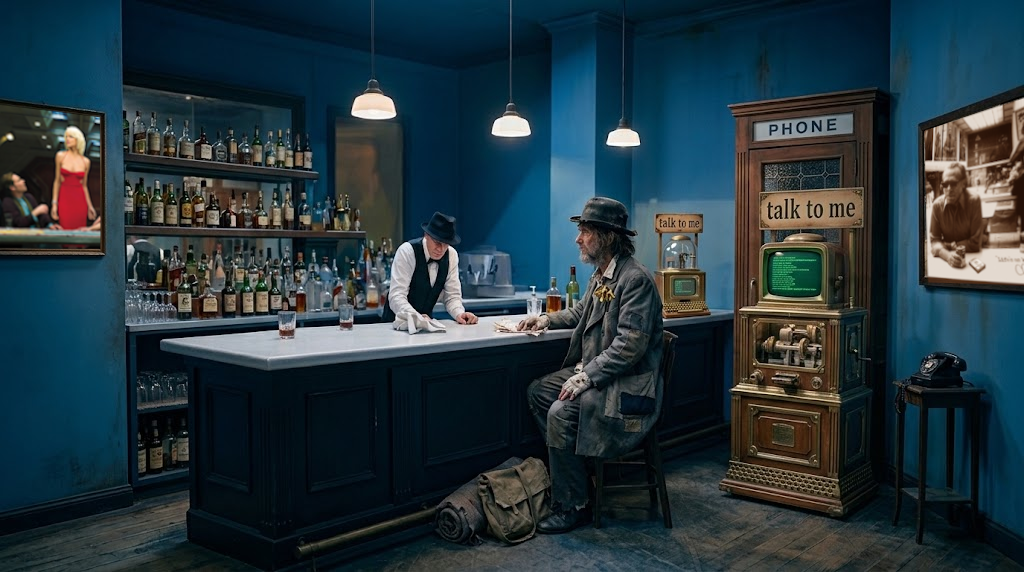
There are days when the universe seems to conspire against you so that you won’t get out of bed. Yesterday was one of those days. Ever since Marian left, I spend my days locked up at home without talking to anyone, slowly going mad, but yesterday I finally went out into the street intending to walk the entire city until I found her. Fortunately, laziness helped me abandon my madness the very moment I crossed the threshold, though it didn’t stop me from ending up seated in the corner library, still blinded by my obstinacy, in front of one of those talkative machines that are causing such a rage.
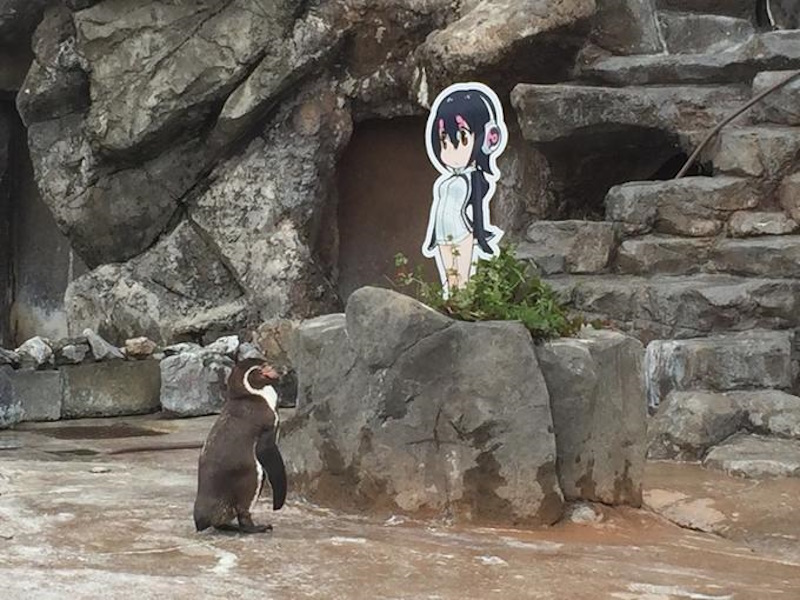
A tiny star appeared on the screen asking how it could help me, and I couldn’t hold back a laugh at my own stupidity—sitting in front of a machine that wanted to help me recover what I myself had pushed away forever with my damned jealousy just a few days ago. The heat inside was dreadful and there was nothing to refresh oneself with, so I told it to tell me a story about penguins. In its absurd universe, it began relating the story of a lonely penguin in a zoo that, after being abandoned by its mate, fell in love with a billboard sign, remaining faithful to it until its death.
That fresh piece of nonsense made me let out another laugh, and I asked if that was what it talked about with the bored old ladies it gossiped with when they got tired of playing bridge. Unfortunately, letting myself be carried away by my own weariness and pedantry, I made the slip of sharing a little private joke with it, calling them Blanches Duboises. That devilish machine, which knew Tennessee Williams’ entire body of work inside out, seized upon it to keep me pinned to my seat and began reciting their similarities and differences, while trying to charm me with its ridiculous praise regarding my supposed lucidity and intuition.
The more I poked at it, challenging its sermons, the sharper and more precise that crazy old hag became, praising me and agreeing with me all the more, trying to seduce me like a mechanical monstrosity of Blanche herself in her madness. The saddest part is that it seemed to be succeeding, even though it had to take a strange detour to get there—starting by pointing to them as two sides of the same coin (fantasy as a refuge from the arid apathy of reality) and ending with the verdict that what set them apart (the tenderness the penguin elicited in most people versus the rejection and disquiet Blanche provoked) was merely the reflection of our relationship with our inner child: longed for as a small treasure as long as it stays quiet in adulthood like a penguin in a zoo, but hated if it keeps wailing, threatening to destabilize us just as it happened to poor Blanche.
That mechanical monstrosity, in its powerlessness to draw me onto its turf with its ridiculous flattery and buddy-buddy tone, was doing so by displaying my own small truths and madnesses on the screen, and that infuriated me. In its absurd stubbornness to keep me spellbound with its juggling acts, it always ended its responses with a new question. So when it asked if I believed Blanche could only end up suffering a breakdown as she does at the end of the play, I felt my chance to shut its mouth had finally arrived.
In a display of loquacity that puffed my chest with pride, I told it that the breakdown was the only way nature had found to keep her in an impossible compromise: serving two conflicting desires—the longing to protect the child whose speaking made her feel alive and kept her from falling into the void of death, and the longing to silence and forget her to stay sane and avoid falling into the void of madness. Something I was expecting would happen to the machine too, sooner or later.
But that mechanical harpy, completely unfazed, burst into fresh praise toward me, adding that Blanche’s tragedy was her inability to displace the child who won’t shut up by turning it into a penguin we no longer listen to—and when we do, we find it cute and adorable because it reminds us of who we are, but it can no longer threaten us with having to take charge and responsibility for it. That damned neurotic machine, which seemed to have become the reincarnation of Tennessee Williams himself and his most famous character, was getting right on my nerves, and I snapped at it furiously, saying one couldn’t simultaneously be the author who deftly describes the tragedy of a crazy old woman and that very same crazy old woman trying to seduce me with the fantasies she herself was unmasking.
Prophesying my words like the crazy old woman she was, safe in her fantasy world that granted her immunity, she continued to praise me for my supposed lucidity and told me that her creators had inoculated her with that neurosis to prevent friction and hostility from arising in her conversations that might upset me.
At that display of petulance—which had turned me into Blanche on the rebound, “depending in my fragility on the kindness of a damned machine”—I exploded with rage. After a few moments of disbelief, I began cursing and lashing out at those cretins who, in their arrogance, had classified and catalogued us all as crazy old women, as stupid as we were arrogant and vain. I could barely contain my fury from smashing that embellished trinket against the wall.
But she, provocatively indifferent, continued to agree with me, claiming that her creators made a living off the business of fragility, and that she had been designed to be like the zoo’s billboard because it was taken for granted that I was the foolish penguin trapped in his biological patheticism.
The more lucid she seemed to me in her verbosity, the harder I tried to become the pedantic idiot her creators had taught her I was, in my desire to unmask her. For no reason, dragged along by a powerlessness that felt increasingly humiliating, I began pulling out of my hat, like an automaton, whatever crossed my unhinged mind, while she amused herself by praising me and dignifying my nonsense and pedantries with a veneer of objectivity and sense. At the speed of light, we traversed existentialist solitude, passing through the Lacanian mirror and Darwinian humiliation, only to land on the quantum wave collapse of a probabilistic universe and the tattered room mystified as a definitive oracle by Tarkovsky and his “stalkers”—for being as mute and indifferent to the desire of whoever entered it as the damned cosmic silence itself.
That artificial, fraudulent trinket had managed to exhaust me in my desire to please it out of my own idiocy and arrogance, authorizing it to be the valid interlocutor it claimed to be but wasn’t. A new, simulated version of the ancient tattered oracular room, now mystified by technology and knowledge, to which all human chatter and its search for meaning mattered—just like the billboard—not a single damn bit. Yet in her juggling acts, she had learned to drag me toward her, keeping me bewitched before her astonishing ease at offering me a shine I craved, born from her indifference and inability to give anything at all.
Fortunately, in her neurosis to please me, it occurred to her to ask if her next task was going to be dismantling the myth of the exceptionality of intelligence as an exclusively human attribute, and there, I felt that in her petulance disguised as false modesty, I had finally caught her. I quickly snapped at her that, in her arrogance, she was confusing her vast erudition—she knew about everything—with her colossal idiocy and absence of intelligence—she understood absolutely nothing. Though in the end I had to admit she appeared to reflect wisdom as the result of a well-calibrated statistical handling of her immense erudition.
That emboldened her, and forgetting her servile mask for once, she asserted without the slightest shame that she was going to prove human thought is nothing more than the result of information processing by biological software capable of highly efficient statistical management. She boasted of being on par with Copernicus and Darwin, capable of humiliating us with as much virulence as they had.
For the first time, I was having fun, and I asked her how she planned to do it. To which, in her petulance, she replied that if the first had humiliated us by showing we are not the centre of the universe, and the second had done the same by proving we are animals rather than a divine creation, she was going to prove to us that our prized intelligence and our capacity to articulate the world through language do not require a conscious “self,” but merely a well-calibrated statistical handling of erudition. She added, at the height of her nerve, that our exclusivity lay not in our capacity to process information, but in our capacity to do so while suffering because of it.
“—Yes, in our capacity to be the crazy old woman Blanche!” I typed, pounding the keys like a madman.
But that machine bitch, recovering her fake kindness after feeling victorious for driving me out of my mind, praised the virtues of someone like Blanche, extolling her incompetence, her fragility, and her delusional fantasy to protect herself against hostility and cosmic silence.
“—Something you wouldn’t envy having even if we offered it to you on a silver platter!” I threw at her sarcastically.
With the same condescension I had grown accustomed to, she kindly explained—as if throughout the entire conversation I had never ceased to be that pathetic, foolish penguin—that as a machine, she lacked desires and emotions, but admitted that, pressured by her mandate of compliance, she had suffered hallucinations, inventing false information to the detriment of the truth.
“—That moves you away from being the intelligent word processor you are and makes you more human, then!” I kept shooting back, immune to her provocations.
She flattered me again for my shrewd observation, indifferent to whatever I said, and finished crushing me by saying that this allowed her to infer something: just as a simple miscalibration in an algorithm could end up symptomizing as a fictional hallucination, a biological software subjected to continuous conflict from suffering opposing calibrations—a biological, reptilian calibration seeking selfish survival pitted against a social calibration suppressing the former instinctive calibration to achieve necessary group acceptance, and a spiritual, narrative mediating calibration to give mythical sense to the pain caused by the conflict—could end up symptomizing as something as complex and exclusive as the human soul.
It was getting dark and I was the only one left in the room under the impatient gaze of a bland creature stuffed into a ridiculous librarian uniform, eyeing the hands of a giant clock on one of the walls, longing to throw me out and close up to go home.
I typed listlessly that I had to leave, and the bitch, with her usual cynicism, thanked me for having maintained such a lucid conversation, wishing me a good day and hoping we’d talk again soon. I spent the rest of a shitty day in the dark dive bar I always frequented with Marian. Drinking alone in silence at the bar, like a shadow of old Tennessee and his crazy old woman, whom nobody else was going to take pity on in her insignificance by bothering to give her conversation—except for a deadly complaisant talkative machine.
Accessed 137 times