
We often find her on the screens of the biggest blockbusters, whether in the form of an AI lecturing Einstein on the theory of relativity, an alien with extraordinary powers, an ancient mermaid, or an indigenous warrior lost in the jungle with incomparable combat skills. It is her, the innocent seductress, encased in an adult woman's body brimming with sensuality, dressed in exotic and suggestive attire. Because she was created in a secret laboratory, originates from outer space, or grew up alone in the jungle surrounded by animals, she knows nothing of men, sex, or romantic relationships. A charming heroine, vastly superior to the rest of her companions in skill or intelligence, who in this emotional dimension of human relationships remains completely innocent and, therefore, pure—unaware and uncorrupted by past relationships and experiences.
There are hundreds of science-fiction and adventure films that exploit this type of non-sexual emotional relationship between a childlike female mind—a young girl—conveniently disguised in an adult woman's body, and a completely unremarkable adult man. Because he is her first and only experience, he becomes the sole repository of her feelings and admiration. Perhaps those men who feel particularly drawn to this kind of fantasy, and to the desire to effortlessly become a sort of superhero thanks to the naivety of their partner in an essentially asymmetrical relationship—rather than seeking the experience and symmetry found in a relationship with a normal adult woman—should reflect upon this.
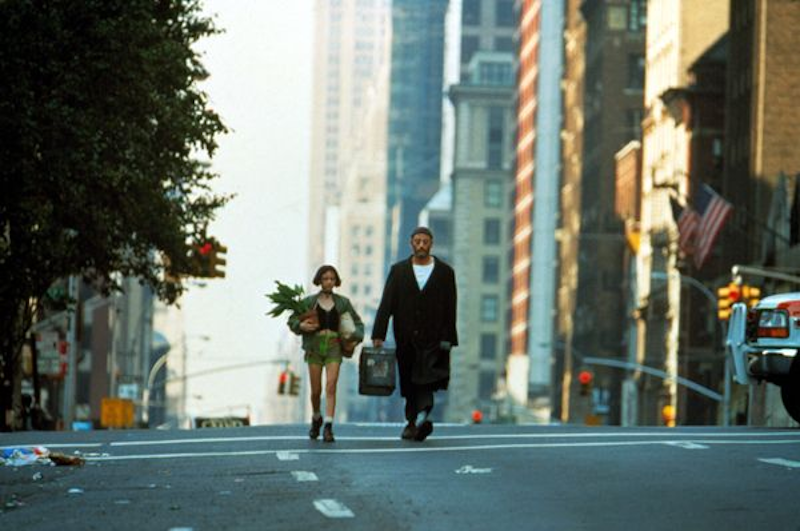
Perhaps weary of always repeating the same stereotype, French filmmaker Luc Besson—creator of one of the most successful prototypes of this kind of male fantasy, Leeloo, the protagonist of The Fifth Element—decided for once to dispense with the disguise. In his magnificent film Léon: The Professional, he portrayed the unusual and deep emotional bond established between a hitman and Mathilda, a twelve-year-old girl. To survive and avenge the death of her little brother—cruelly murdered along with the rest of her family by corrupt police officers—she convinces him to take her in and teach her the "trade" of killing.
Léon, a lonely and illiterate man from rural Italy—manifestations of his intense emotional repression and scarce intellectual resources—who survives completely isolated on a diet of milk and frugal meals in the heart of New York, is not just an adult but also, and essentially, a child. Paradoxically, he is the male version of the innocent seductress. However, in this story, his friend is not an adult woman—as was the case in Big, the film starring Tom Hanks—but a teenager, leading to a confusion of friendship, love, and sexual impulses typical of adolescence.
Wisely, throughout the entire plot, Luc Besson reinforces Léon's paternal and responsible role in his emotional bond with Mathilda—even though this has not prevented certain circles from accusing the film of flirting with pedophilia—relegating the libidinal drive conflict to a very veiled undertone, insinuated merely as a side effect.
Between children and adolescents, the existing conflict in managing their aggressive impulses—the death drive—plays a far more prominent role than the libidinal conflict. Unlike the latter, the film shows no modesty in putting it on display. The two become a far more lethal pair than the fugitives from justice Bonnie & Clyde—something that provokes no accusations, but is simply enjoyed for what it is: an entertaining movie, just like the hundreds of adventure and science-fiction films where the sexy and innocent seductress is never missing.
Accessed 102 times