
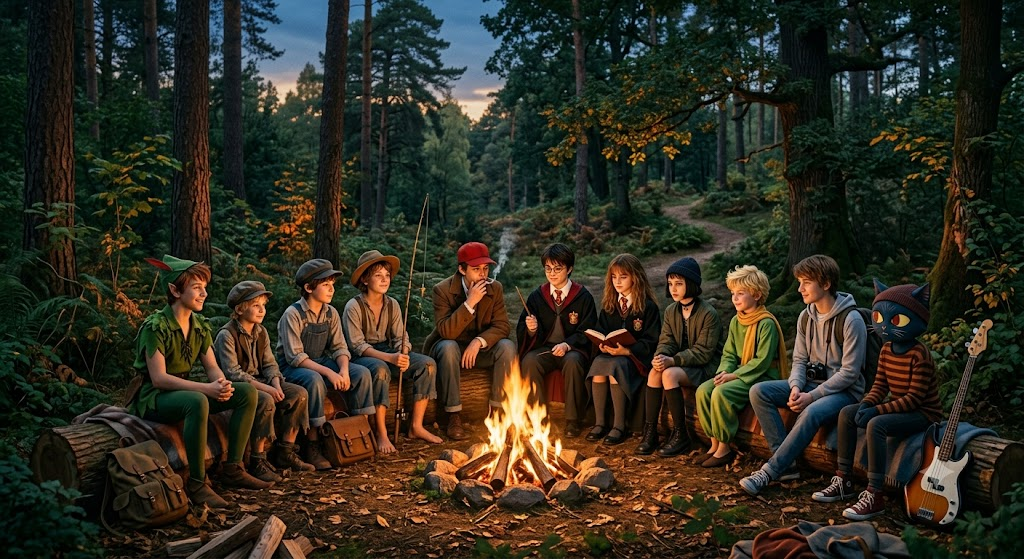
"A man's true homeland is his childhood." — Rainer Maria Rilke
Sometimes I think a dog is like a child who refused to grow up so as not to lose faith in human beings, though it proves to be far too high a price to pay. The only human who perhaps did so, Peter Pan (1), paid a terrible price for it: amnesia, and with it, his very humanity.
If the real or figurative orphans of the 19th century—such as Oliver Twist (2) or Pelle (3)—represented a helpless childhood in an adult world of pure perversion, crime, and selfishness, they did not enjoy the privilege of suffering an existential crisis. For them, the danger of maturity was not becoming a kind of hypocritical, domesticated idiot, but rather a criminal, a slave, or a corpse. Throughout the 20th century, however, narrative stopped throwing its youth into physical battles for survival to lock them inside their psychological conflicts, highlighting in all of them the trauma of moral exposure caused by the disappearance of the adult man.
The Crisis of Masculinity and the Absent Father
With the Industrial Revolution and the consolidation of wild capitalism throughout the 20th century, the mature man was uprooted from the family core to become a gear in the machine of production. The father went from being a present figure and a master of life to a mere distant financial provider, bringing about the collapse of the father as an ethical guide, the crisis of patriarchal society, and the breakdown of the paternal role.
The common thread uniting all these characters in the face of the trauma of transitioning into adulthood is the resignation of the father. Whether through death, abandonment, or having become a cold cog in the system, the mature man has vanished as an initiatory guide. The father no longer educates; he is either an abstract threat paying the bills or a spectrum humiliated by the economy. Lacking this bridge to the outside world, young people have no healthy mirror of maturity in which to look at themselves. Adult masculinity is inevitably associated with submission, violence, or the theatre of appearances.
In the 19th century—Tom Sawyer (4), Pelle the Conqueror (3)—the father is still physically present, but the economic system has already emasculated and defeated him; he is a father stripped of his moral authority. Pelle's father is a good man whom Pelle looks at with love, but he is also a weak old man who bows his head before the landowner. Pelle discovers the void of the father not because he abandons him, but because he realizes his father is powerless to protect him from the cruelty of the world. Here, adult masculinity is associated for the first time with submission or defeat.
By the middle of the 20th century, the father has become an abstract, distant, and unrecognizable entity, or has been replaced by a sadistic, ruthless stepfather. Holden Caulfield’s father (5), a wealthy New York lawyer, is conspicuous by his absence. He has no voice in the novel; he is merely an abstract punitive force. He is a father who does not educate, listen to, or comfort Holden after the death of his brother Allie; he simply pays for the expensive boarding schools from which Holden is constantly expelled. For Holden, the successful adult man is an empty, detached, and deeply hypocritical (phony) being. Holden refuses to grow up because the only mirror of adulthood he has is that of a cold bureaucrat. Opposing him, Alexander’s bishop stepfather (6) represents adult hypocrisy taken to the extreme of sadism: a man who destroys childhood in the name of moral "purity".
In the late 20th and early 21st centuries, the crisis of masculinity deepens even further, and the adult man ceases to be the cold, absent provider to transform into a man-child who refuses to take on responsibility, frequently abandoning his financial and family duties out of an inability to bear the weight of his economic and social frustration. Billy Casper (7)—Holden Caulfield’s British working-class counterpart—lives in a mining town, ignored by his mother, mistreated by his brother, and condemned by his school to end up in the pit like all his peers. Yet, in the training and care of a kestrel, he finds the only truth and beauty of his life. Antoine Doinel (8), misunderstood by parents and teachers alike, faces a hostile environment daily both at school and in his own home, slipping into truancy and petty theft in a descent toward delinquency to escape this oppressive reality. Dell Parsons (9), too, following an absurd event—a bank robbery committed by his parents, who were drowning in debt—experiences the collapse of his life and that of his twin sister, Berner. When their parents are arrested and Berner flees home without looking back, Dell is left completely alone facing the threat of ending up in a state orphanage.
Whether through death, abandonment, addiction, or total absorption as a cog in the labor system, if the father represents the terrible absence pushing all these youths toward the cliff—a vacuum of everything that traditionally represented law, order, and the initiatory bridge to the outer world—the entire emotional burden, tension, and responsibility for filling this structural void falls upon the mother.
Often, the mother becomes an "Accomplice to Domestication," forced to assume the role of the absent father. She must impose discipline, earn money, and ensure the child fits into the system to survive, causing the adolescent to perceive her as a traitor—as the direct representative of a phony, hypocritical adulthood they reject. Alexander’s mother, Emilie, having been widowed, makes the mistake of remarrying the ruthless Bishop Edvard Vergérus out of desperation for security and stability for her children, becoming in Alexander's eyes an unwitting accomplice to the monster trying to destroy them. Antoine Doinel’s mother is a cold figure, overwhelmed by guilt and her own secrets—Antoine discovers she has a secret lover—incapable of bearing the weight of the household, eventually handing her own son over to the authorities. She is the mother who surrenders to the system.
In social narratives where the father's absence is economic or tragic (workplace death, abandonment through alcoholism), the mother is often an "Overwhelmed and Peripheral" character, numbed by her own precariousness, lacking the mental or emotional capacity to manage her children's trauma. Billy Casper’s (7) mother works tirelessly, is frustrated, and desperately seeks a boyfriend to pull her out of misery, showing herself completely incapable of understanding Billy or his connection to the hawk. Her emotional blindness is the result of sheer social asphyxiation. In Les Diables (10), the absence of both parents is absolute. The children are abandoned in the institutional system, turning Joseph into a simultaneous "mother and father" for his sister Chloé. Absolute maternal absence leaves a wild, ungovernable wound.
Within a more subtle yet equally devastating dynamic, the mother can also appear as an "Unattainable Refuge". Holden’s father is a rich corporate lawyer, a distant figure appearing in the text only as an economic threat or punishment ("my father's going to send me to a military school"), while his mother, though physically present, is emotionally absent due to unresolved grief over the death of Allie, Holden's younger brother. Holden describes her as an extremely nervous woman who smokes incessantly at night and never sleeps. Here, a tragic inversion occurs: Holden does not hate his mother; on the contrary, he seeks to protect her. When he sneaks into his own home to see Phoebe, he does so with a terrible panic of being discovered—not out of fear of punishment, but out of fear of breaking her heart again. The mother is a sacred yet fractured territory; Holden self-exiles so as not to cause her any more pain.
In a final dramatic twist, we find Harry Potter (11), where the father’s absence—James Potter—is total, but the mother’s figure—Lily Potter—seems to rise to the level of a foundational myth. In Rowling’s work, the mother is neither an agent of domestication nor an overwhelmed figure, but an absolute protective shield. The "mother's sacrifice" is the oldest magic in the world, the one that protects Harry from death. In a far more idealized and commercial vision—symptomatic of a persistent desire to repair an initial orphanhood—the entire saga is Harry’s attempt to live up to the love of that absent mother.
The Adult as the Cringe Character (The Tyranny of the Phony)
For all these characters, growing up is not evolving, but corrupting oneself. Holden Caulfield popularized the term phony (fake, hypocritical, impostor) to describe adults—pathetic beings who are always acting. Current generations have rebranded this concept as cringe: that second-hand embarrassment caused by watching someone constantly act to maintain status, neglecting the truth. Facing this outlook, young people experience a visceral panic of social domestication—the tyranny of appearance of our century. They prefer isolation, marginality, or madness over becoming just another cog in the adults' farce. In a world where everyone acts for a camera, the greatest social danger is losing authenticity.
At the opposite pole of cringe lies childhood: the realm of the based (the authentic, real, pure, and not yet corrupted). For a teenager like Holden (5), this is personified in his little sister, Phoebe, or in the memory of his deceased brother, Allie. For Mathilda (12), it is her little brother brutally murdered by the police in her own home, or León, a lonely, illiterate hitman (manifestations of his intense emotional repression and scarce intellectual resources) who survives entirely isolated on milk and frugal meals in the heart of New York. León is not just an adult, but essentially a child as well. Children have no filters, do not seek the approval of a social algorithm, and do not pretend to be who they are not; they simply are.
Faced with the tragedy of becoming an adult, some will see themselves as the last line of defense against the fall into the abyss. When Holden imagines his ideal job—being the catcher in the rye—he sees himself at the edge of a cliff, guarding thousands of children playing in a field of rye. His mission is to catch them before they fall into the void: maturity, the moment they will lose their authenticity and begin to worry about appearances, entering the game of social hypocrisy and becoming corrupted into just another fake, cringe adult. Holden wants to freeze time to save them from this pathetic destiny.
Similarly, Joseph (10) becomes the literal guardian of his sister Chloé against the outside world. She has become the only valuable thing in his desolate existence, leading him to fall into absolute marginality and shared madness in a desperate attempt to reunite with the original mythical object: the house Chloé incessantly builds with mosaic pieces as part of her stereotypical autistic behaviour, which will save them both from their orphanhood, suffering, and desolation.
The Mind as the Only Means of Escape
If Mark Twain introduced modern childhood and pre-adolescence into American literature, J. D. Salinger represents the exact moment when these literary characters transitioned from having to face the dangers of the physical world to having to confront the demons of their psychological world.
Tom Sawyer is the rebel "within the system"—he breaks the rules, skips school, and runs away from home, but he is driven by a spirit of adventure. In the end, Tom wants society to accept and applaud him as a hero. Holden, by contrast, detests this applause; to him, Tom’s desire to fit in and be admired by adults would be the epitome of being a phony.
Huckleberry Finn, Tom Sawyer’s partner in adventure, is Holden’s true soulmate. Huck flees civilization on a raft down the Mississippi River because he rejects the hypocrisy of an adult society that condones slavery and violence, preferring to "go to hell" rather than betray his friend Jim. Holden does the exact same thing: he flees his boarding school and loses himself in New York, searching for that same spiritual "raft" far from adult civilization. But unlike his predecessors, Holden lives in an urbanized, domesticated world where a physical space to flee to no longer exists. Sailing down the Mississippi is no longer an option, so his only possible escape is inward, into his own mind, which ultimately leads him to suffer a psychiatric breakdown.
Unlike Holden Caulfield, who fights against adult phoniness, most child characters in 20th-century European and American literature fight against an adult world characterized by physical, economic, and institutional violence.
Billy Casper (7) isolates himself in the training of a kestrel. The bird will be killed by his older brother—the representative of the absolute cruelty that often hides behind the hypocritical facade of adulthood—in an act of petty malice that destroys Billy's fragile soul, exposing a system that not only domesticates and perverts childhood, but is also capable of crushing its innocence, confronting it with a terrifying void.
Mathilda (12) becomes an institutionalized child trying to escape the cruelty of the murderers of León and her family, while Alexander (6) takes refuge in his grandmother’s lap, preferring to regress to an earlier stage of childhood.
Dell Parsons (10) exiles himself to Canada, where, despite falling into a brutal and desolate environment under the control of criminals, he uses his analytical mind and patience to survive. He manages to assimilate the trauma without becoming violent or cynical, eventually becoming a respectable, retired high school teacher capable of leading a peaceful, orderly, and conventional adult life. His sister Berner will not be so fortunate; driven by resentment, rage, and rebellion, her life becomes a succession of escapes, poor decisions, unstable relationships, and economic instability, largely replicating the chaos of her parents. When she reunites with Dell at the end of the novel, she is a woman suffering from cancer, prematurely aged, and scarred by the bitterness of an erratic existence.
Tragic, too, are the fates of the sexually abused teenagers in the film Mysterious Skin (13). Just as in Canada, where two people exposed to the same traumatic event in childhood develop completely opposite psychological paths to survive, here Neil McCormick, who remembers the abuse, processes it by becoming a cynical, hypersexual teenage prostitute. Meanwhile, for young Brian Lackey, the pain of accepting that the monster who abused him in childhood was his baseball coach—an adult he was supposed to trust—drives him to invent a fantasy of alien abductions, turning a science-fiction fantasy into the only refuge from an intolerable reality.
The last of these characters in this endless succession of teenagers terrified by the inevitability of a society pushing them to become grey, predictable, hypocritical, and domesticated adults—and also the most famous—is Harry Potter. The entire Harry Potter saga is built on the rejection of a grey, bureaucratic, magicless adult world: the "Muggle World," of which his adoptive parents, the Dursleys, are the grotesque version, becoming a perfect allegory for the emotional orphanhood of contemporary youth.
Much like Holden Caulfield (5) or Mathilda (12) are marked by the death of a sibling, Dell Parsons (9) and his sister Berner by the stupidity and subsequent arrest of their parents, or Neil McCormick and Brian Lackey (13) by childhood sexual abuse, Harry Potter is marked by the murder of his parents—by a "scar" that is the physical manifestation of his trauma. As the saga progresses, especially in the fifth instalment, The Order of the Phoenix, he is revealed as a deeply fractured teenager suffering from panic attacks, rage, and depression. Yet, unlike Holden, he ultimately chooses responsibility over cynicism, becoming an Auror (a cop of the system)—an example of pragmatic maturity from someone who decides to fix the system from within rather than self-destruct in a psychiatric hospital like Holden.
Standing before all of them comes a visitor from outer space—the most elegant revealer of adult hypocrisy and emptiness in literary history: The Little Prince (14). His entire journey through the asteroids is nothing short of a catalogue of adult stupidity: the king obsessed with ruling even without subjects, the conceited man who only wishes to be applauded, the drinker lost in his addictive evasion, the greedy businessman counting stars, the lamplighter trapped in an eternal and futile task, or the geographer imprisoned in a false, purely bureaucratic knowledge. Unlike all the others, he reacts with tender melancholy and compassion. In the end, after leaving us with the truth that adults are incapable of understanding—"what is essential is invisible to the eye," revealed by a fox, someone who, like his peer the dog, accepts being domesticated while refusing to lose faith in human beings—the Little Prince allows himself to be bitten by the snake to abandon his physical body and return to his rose on his planet in a beautiful, poetic suicide so as not to have to grow up on Earth.
Despite belonging to the Boomer generation—those of us who grew up without video games and never paid much attention to them, except to assess what risks they might pose to our children when they immersed themselves so enthusiastically at such early ages, something about which we never had the slightest idea—video games represent a new evolution in narrative. Here, the reader or viewer is no longer placed before a world narrated (fabled) by its creator (a god), but inside a world where the player faces a universe created by a human (its designer) in which they retain a degree of freedom to act out their own desire. The narrative becomes the experience resulting from an activity modified by the player's own actions, by the constant interference of their desire, and by the responsibility of their "playing" in the outcome of their game. In every moment, at every new turn, they experience William Shakespeare's famous quote: "Fate shuffles the cards, but we play them".
Thus, in video games, ideology becomes an interactive experience. Unlike a novel or a movie, where moral lessons are absorbed passively, the player is directly confronted with different ethical possibilities. Experts have noted that contemporary games such as Life is Strange (15) —where the protagonist's name, Max Caulfield, is a direct homage to Salinger and his novel—or Night in the Woods (16) —a snapshot of apathy and youth mental health in rural deep America through its heroine Mae Borowski—have picked up the torch of this emotional orphanhood. Huck Finn’s raft is no longer made of wood, paper, or celluloid: it is now made of bits and pixels, navigating the web.
References
- Peter and Wendy, J. M. Barrie, 1911.
- Oliver Twist, Charles Dickens, 1838.
- Pelle Erobreren, Bille August, 1987
- The Adventures of Tom Sawyer, Mark Twain, 1876
- The Catcher in the Rye, J. D. Salinger, 1951
- Fanny och Alexander, Ingmar Bergman, 1982
- Kes, Ken Loach, 1969
- Les Quatre Cents Coups, François Truffaut, 1959
- Canada, Richard Ford, 2012
- Les Diables, Christophe Ruggia, 2002
- Harry Potter (saga), J. K. Rowling, 1997-2007
- Léon, Luc Besson, 1994
- Mysterious Skin, Gregg Araki, 2004
- Le Petit Prince, Antoine de Saint-Exupéry, 1943
- Life is Strange, Dontnod Entertainment, 2015
- Night in the Woods, Infinite Fall, 2017
Accessed 102 times