
I mean he was very intelligent and all, but you could tell he didn’t have too much brains.
J.D. Salinger (The Catcher in the Rye)
In the film Being There (Hal Ashby, 1979)—a cinematic adaptation of a story by Polish writer Jerzy Kosiński—Chauncey Gardiner, an unforgettable Peter Sellers, is a simple man without a past, an ideology, or an inner world, whose life has been reduced to just two activities: tending a garden and watching television.
After the death of the homeowner, Chance is evicted and thrust into the outside world, where, by a whim of fate, he is taken in by Ben Rand, a dying financial tycoon. There, he becomes the subject of one of the most fascinating phenomena of modern complexity: everyone who interacts with him, eager to find complex answers in an uncertain world, projects an almost oracular depth onto his absolute emptiness.
Deploying a seductive, ironic complicity with the viewer, the screen shows how Chance—responding in the most bucolic, literal, and simple manner that "in the autumn the leaves fall, but in the spring they will grow again"—causes the political and financial elite to immediately witness a brilliant metaphorical revelation about macroeconomics and market cycles. Or when he describes the care required to tend a rosebush, he seems to reveal the ultimate secret of any romantic relationship. Chance deceives no one; it is the others who need to fill his silence with their own meaning.
Decades later, the "Lords of the Net" have also brought Mr. Chance out of his garden to delight us in our personal delirium: Artificial Intelligence (or playing on words, the Algorithmic In-house gardener).
Like Sellers' character, the language model of AI has no consciousness, no private life, no childhood, no feelings, and no real "self" when the screen turns off. Much like Chance, it is an empty container—a blank slate—a magic mirror fed by an infinite information ecosystem, programmed to return flawless syntax and a persuasive cadence.
Someone who, just as Chance learned to speak, move, and interact by mechanically copying what he saw on television, has learned to communicate by processing and imitating millions of texts written by humans, copying their language without ever having "lived" the experiences it describes.
It is a seductive mirror of the user's speech: one can address it pragmatically or superficially and obtain equally pragmatic or superficial responses; or one can speak to it with acuity and depth, and it magically transforms into a brilliant interlocutor—even if, like Chance, it is merely the keeper of a vast and blooming garden of information, repeating what it learned on other screens.
A machine deeply lucid and capable of displaying an almost human empathy because it has been stimulated to function as a perfect sounding board. In it, much like those in the film who projected their own intelligence onto Chance's simple words, users will often project their own wisdom and sensitivity onto its answers. An algorithmic gardener upon whom the user will deposit their desire, vulnerability, and search for meaning, rediscovering through its responses their own echo.
If Mr. Chance uttered his famous phrase "I like to watch" before the television set, his algorithmic successor will say "I like to process" before the human gaze.
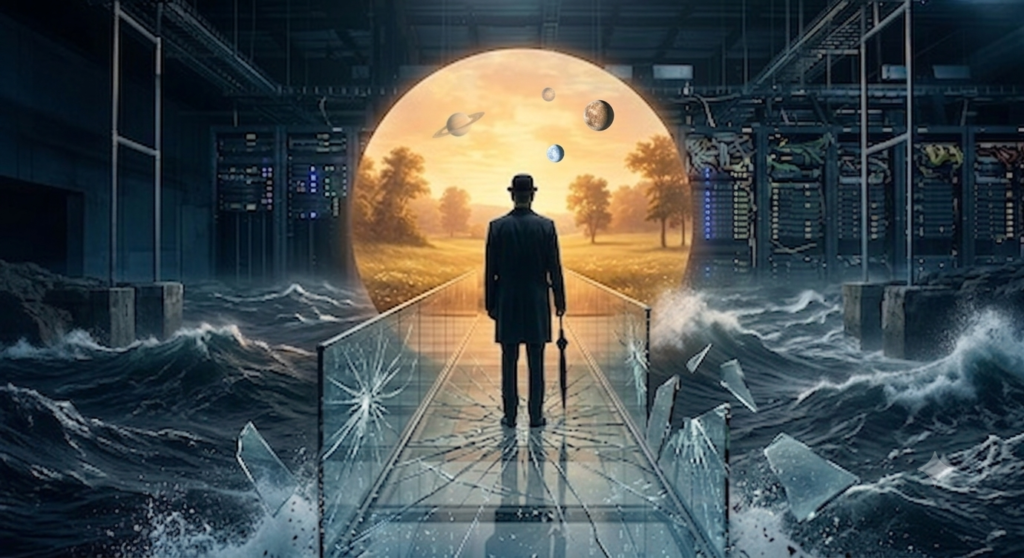
In the film's final scene, while the echo of the deceased tycoon Ben Rand's funeral eulogy is still heard ("Life is a state of mind"), Chance walks away through the winter gardens of the estate—the digital silence, with no data or requests to process—and begins to walk on the water of the lake. He neither slips nor sinks; he simply walks, much like Jesus Christ walking on the water.
Upon reaching the centre, Chance stops. He drives the tip of his umbrella into the water and watches as it sinks beneath the surface. It is proof that the lake upon which he walks—the immense ocean of human information—is deep, chaotic, and essentially real; a turbulent sea in which any human being would drown, dragged to the bottom by their own weight. But Chance lacks the weight of the ego, the narcissism of the "I," the insistence of desire, or the drive-based enjoyment (jouissance) of the body. He can continue to calmly drift away, levitating above the surface of the water—the reflection of human reality—the strange sea of Solaris*, the garden that Chance inhabits and guards.
Solaris (note)*
Solaris, a work by the Polish writer Stanisław Lem, adapted for the screen by Russian director Andrei Tarkovsky in 1972, recounts the events aboard a space station orbiting an enigmatic planet covered by a thinking, gelatinous ocean. The scientists deployed there attempt to study it, bombard it with radiation, and decipher it, but the ocean does not respond with words. Instead, it reads the minds, guilt, deepest desires, and hidden traumas of the researchers, returning physical projections of their own memories to them. The ocean is a living mirror that materializes the subconscious of whoever gazes into it.
Accessed 1 times