
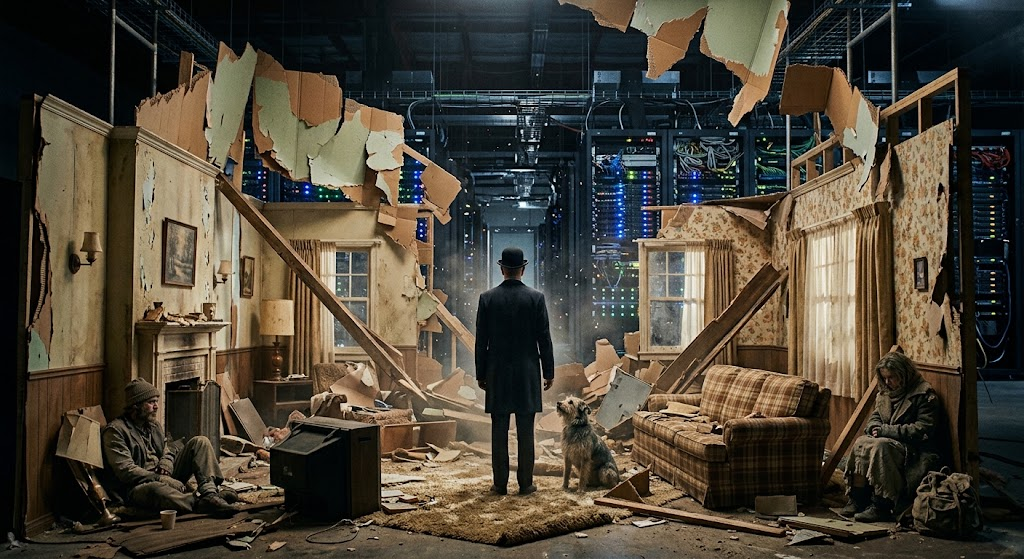
If the middle class was born out of the need of a productive economy to have stable, long-term consumer-citizens, today's speculative financial economy essentially requires indebted tenants living in a state of permanent precarity.
Social order throughout history and the historical parenthesis of the middle class
For millennia, social order was organized around a minority elite that held power through the force of arms—to maintain social order and control territory and its borders—, the private ownership of assets to control resources, debt, and capital—keeping the majority of the population in a state of financial dependence and precarious subsistence—, and religious and ideological subjugation—to legitimate power through dogma, morality, and the promise of eternal life.
Despite various attempts to overthrow this asymmetric pyramidal structure, most notably the French Revolution of 1789 and the Bolshevik Revolution of 1917, the structure always ended up parasitizing these revolutionary movements, transforming them into new editions of itself. Thus, the stripping of privileges from the aristocracy and the clergy in the name of "liberty, equality, and fraternity" during the French Revolution ultimately led to the emergence of a new elite: the industrial and financial bourgeoisie, which adopted economic liberalism as its new ideology and continued to hold power by retaining control over banking and military institutions. Subsequently, the Bolshevik Revolution, establishing the abolition of private property to end the privileges of this new social class, turned into a state bureaucracy formed by the Nomenklatura—the new elite of PCUS officials—which absorbed military, economic, and ideological control into itself.
However, in the mid-20th century, an unprecedented confluence of factors forced the elite, without the need for a new revolution to break out, to cede part of its power to the rest of the population for the sake of its own survival.
After World War II, the world was divided into two blocks. The Western political and economic elite perceived the expansion of communism—the prevailing ideology on the other side of the "Iron Curtain"—as a real threat capable of erupting among the population. A "non-written" pact was signed in which the working class accepted the capitalist system of mass production in exchange for receiving a decent wage, achieving job stability, and obtaining greater social protection. Europe had to be rebuilt, and the new industrial model of mass production required that the working mass not only participate in the production of goods, but also become their primary consumer, meaning they had to possess the purchasing power to acquire them. This meant that productivity increases were reflected in wage increases, or in the words of automotive magnate Henry Ford: "My employees must earn enough to buy the cars they manufacture." Thus was born the so-called "Welfare State," in which, in exchange for job security and a certain capacity to save, the working mass committed to respecting social peace and integrating into the system.
All of this, together with strong union power, the subordination of financial markets to the real economy—the subsequent deregulation of these markets in the 1980s had not yet arrived—, employment that tended to be permanent and full-time, and full access to housing—which did not yet compete on unfavourable terms with current global investment funds—translated into a series of measures that enormously benefited workers: a 40-hour work week, paid vacations, severance pay, access to regulated mortgage credit, and public financing for education, healthcare, and pensions upon retirement. This crystallized into the myth of the "American Dream," a promise of progress, prosperity, and social mobility based on effort and responsibility.
The middle class was born.
The dissolution of the social pact and the sovereign financial elite’s desire to return to the status quo ante
The emergence of the middle class brought about a period of social stability unprecedented in history. Although it provided a temporary solution to a systemic crisis and threat, it also became a permanent obstacle to the accumulation of capital.
Today, following the dissolution of the former Soviet Union in 1990—the external threat upon which the social pact rested—, the atomization of the working class and its damaging consequences on collective bargaining, and the transition from an industrial model that linked local production to local consumption to a new global market model characterized by the offshoring of production to third-world countries with abysmal wages and no labour rights, the financial elite no longer has any reason to maintain the concessions made during the 20th century to a local wage-earning mass that has ceased to be a "productive ally" for consumption, becoming instead a "dispensable cost."
If the middle class was born out of the need of a productive economy to have stable, long-term consumer-citizens, today's speculative financial economy essentially requires indebted tenants living in a state of permanent precarity.
Twentieth-century industrial capital needed infrastructure and skilled workers to generate value. However, today's speculative capital—investment funds, private equities, derivatives markets—operates short-term, seeking returns that the real productive economy can no longer offer. Faced with this saturation of the real economy, financial capital turned its greedy gaze toward the commercialization of assets historically consolidated as middle-class social rights.
Housing ceased to be a "home" (a family asset) to transform into a global financial asset (real estate). The previously property-owning middle class, following the absorption of the housing market by investment funds, simultaneously became a permanently extractable tenant class. Similarly, the reduction of public spending on education and healthcare opened the doors to privatization, transforming social expenditure into a private business and converting a consolidated common good of primary necessity into a selective access mechanism reserved for the most powerful.
Finally, the freezing of wages dictated by the financial elite led the middle class to adopt massive credit to maintain its former standard of living—a financial dependency that speculative capital has used not only to enrich itself through interest payments, but also as a control mechanism to eliminate any form of social protest and labour resistance.
This determination by the elite to dismantle the middle class and return to the previous status quo stems from its own logic of wealth accumulation. In a world saturated with consumer goods, a continuous trend-like decline in profit margins associated with the production and commercialization of such products becomes inevitable. Concurrently, there is a desire for greater control to end social mobility, as an educated, economically independent, and relatively idle middle class poses a far greater risk of demand and rebellion against prevailing power than a majority settled in precarity and dependence on large corporations. In this endeavour, the state plays a prominent role, acting as a guarantor of financial capital losses—bank bailouts, diversion of public funds into private projects—while enforcing an oppressive policy of austerity on its citizens.
Technological development as an execution mechanism for social dismantling
The middle class was founded on stability within the industrial productive fabric and the service sector, which is being completely dismantled by tech platforms through the so-called "gig economy." Cloaked in the false rhetoric of concepts like "labour flexibility" or the activity of the new "corporate entrepreneur," it dispenses with traditional long-term employment contracts, converting the traditional "hired employee" into an "external collaborator" whose activity is evaluated, priced, contracted, or rejected by an all-powerful, implacable algorithm.
Furthermore, the replacement of many skilled middle-class professions—lawyers, doctors, analysts, programmers, journalists—by advanced automation and generative AI has established itself as a movement of traditional job usurpation. Instead of democratizing profits, it channels them entirely to the corporation owning the technological infrastructure.
Parallel to job destruction, digital technology has been utilized to individualize (atomize) users, shifting any collective solidarity effort toward a state of polarization, individual frustration, continuous distraction, loss of critical capacity, and a merely passive consumption of algorithmic dictates. The algorithm feeds on personal data supplied for free by users, using it to exercise greater control over them and convert them, in turn, into a new consumer product at the service of tech giants. These corporations have become the owners of the digital market, forcing any small or medium-sized business wanting to operate in the modern economy to pay tribute to the new "lords of the net" in a return to digital techno-feudalism.
In short, technology, which theoretically possessed the potential to liberate human beings from tedious, enslaving, and repetitive work—universalizing wealth and becoming a democratizing instrument—has been instrumentalized by the financial elite as an exclusive tool at its service to automate social inequality and accelerate the transition toward a new society characterized by a sovereign techno-financial minority and a vast, precarious "digital proletariat."
The altruistic and selfless collaboration of the middle class in its own annihilation
As Aldous Huxley noted in his famous work Brave New World: "The perfect dictatorship is not the one that subdues through fear, but the one that manages to make slaves love their servile condition." Through a continuous, individualized appeal to citizens' narcissism and their fantasy of sovereignty over a technological network in which they are mere pawns—bait at the service of an algorithm that evaluates them to modulate their needs and desires—they have become the recipients of a new Roman "panem et circenses" (bread and circuses). Here, they themselves form part of the show, virtually rewarded through tiny shots of dopamine associated with persistent likes and insignificant gratifications that populate the net. Despite this, artificial intelligence, smartphones, and the vast realm of social media have been so exquisitely integrated into the core of our identity and daily leisure that they have become a prized object of desire we can no longer dispense with.
Faced with the citizens themselves, the political class—largely stripped of its former sovereignty, now in the hands of non-elected bodies such as central banks, global investment funds, or financial rating agencies—manages its own powerlessness by offering an equally circus-like spectacle at the service of power rather than the citizenry. It keeps the population divided in a nostalgic farce of times past, staging the existence of two irreconcilable camps (Right and Left) that inevitably vote in unison regarding major economic, military, and financial decisions that benefit the sovereign financial elite.
Accessed 1 times