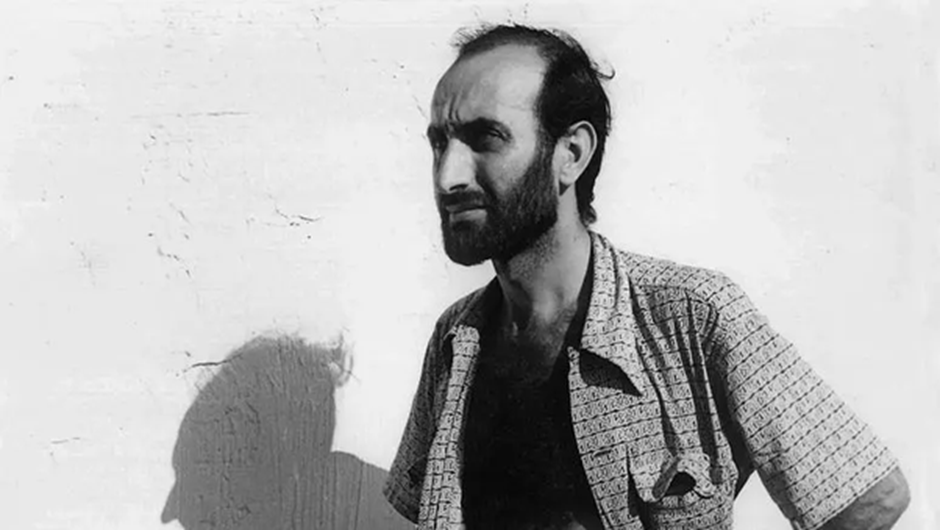
Josep Palau i Fabre taking a break during the shooting of the movie Le Salaire de la peur, Henri-Georges Clouzot, 1953
We find it in the crestfallen gaze of two bodies sitting down to dine in silence out of inertia, as they have every night for years; in the frantic sliding of fingers over a collection of anonymous photographs slipping across the coldness of a screen glowing in the dark; in the lost gaze beneath the aging skin of eyelids that now only wait and dream; or in the anonymity of one who knows themselves invisible to the eyes of the world. These are all masks of the same involuntary confinement that poisons the body.
It is the anguish responding in the quiet of uncertainty to the question: What to do when you feel you could vanish right now and no one would care in the least? What to do when you feel you no longer mean anything to anyone? What to do when what is at stake is no longer your well-being or prosperity, but your very identity and existence?
By fortune or misfortune, that which sustains and structures us—that identity weakness our mind clings to, which some have called the "I"—is the greatest and most precious gift from the Other. For it is by mirroring ourselves in the reflection returned by their gaze that our presence is unified and delimited, granting us an existential certainty.
A gaze that will be neither a right nor a conquest, but a grace: a gift over which we will usually hold little authority or command, and which, just as it was once bestowed upon us, may also be taken away. A gaze that, in its clarity, will bring the unity, coherence, and continuity our identity demands, and in its warmth, the worth our own gaze seeks.
An offering that some, like Josep Palau, knew how to grasp in their wisdom through poetry:
I would give myself to whoever wanted me / as if I did not even realize: / this giving of myself: as if done / by a self of mine that ignored me.
I would give myself to whoever gave themselves / in exchange for me forevermore: / so that nothing of mine remained with me / in the non-mine I received in return.
I would give myself for a kiss, / for a single one, provided it kissed / and unkissed me from the kissed one.
I would give myself to whoever wanted me / as if I did not even realize: / like an alms granted unto me.
— Jo em donaria a qui em volgués, Josep Palau i Fabre, Poemes de l'Alquimista, 1972
A gaze that has made us its hostage, yet will continue to belong to its owner—the one who once freely granted it to us. Trying to retain or demand it through the rancour that poisons memory will prove as futile an endeavour as trying to grasp water with a closed fist.
Yet not everyone will be as humble as the poet. At times, the rawest and most terrifying solitude will not stem from the absence of the Other's gaze, but from the emptiness of one's own. When it is our own gaze that no longer finds an eye in which to mirror itself, all mirrors turn opaque, their brightness fading into a dimmed void.
And the onlooker will realize, as if in a revelation, that the gaze they seek in their anguish and despair is nothing more than the mirage of their own gazing's reciprocity. They will feel that in the one they look upon with devastating intensity—with the burning of a desperate desire to be confirmed—any faint glimmer is reflected back with the glare of a lighthouse; and conversely, the outburst of life and devotion illuminating the person who has become invisible to their eyes will extinguish in the blindness of their own looking.
Clever as they are, knowing that the mirror they seek is merely a mirage, a flash in the pan, a projection of their own looking, they will untangle the mess and reclaim what has always been theirs: their own personal, non-transferable capacity to look at themselves, casting off once and for all their dependency on the whim of the Other. Filled with pride in their wisdom, happy to have freed themselves from the tyranny of the Other and to have conquered their new, luminous solitude—now synonymous with independence and freedom—they will peer into the interior of this new, primal, non-distorting mirror, only to discover in terror a shattered glass: fragmented into a tangle of desires, fears, longings, and contradictions that project only diffuse shadows, fading them—and vanishing them—into the dark.
Faced with the nostalgia and the impossible, mythical childhood wish to rediscover that single mirror in the gaze of an absolute Other who recognizes us as a perfect, unequivocal, and seamless unity—and the tragedy of smashing it to pieces by wanting to be both the gaze and its dazzling mirage—there remains only renunciation: a renunciation in which the gaze discovers the mosaic.
A mosaic of small mirrors that do not reflect the totality of the being mirrored within them, but rather fragments of an identity learning to live by constantly recomposing itself through the discontinuous, imperfect, and brief gazes in which it catches its reflection at any given moment.
Yet if recognizing oneself in this multitude of small mirrors—which are almost always there—is what will pull a person out of the dark, abyssal void of solitude, one must also learn to stop seeking the blinding luminosity of the longed-for, now-broken mirror, and accept, with gratitude, the faint glow of each instant.
One will need, put differently, to have mourned the broken mirror—a mourning that, like that which is impossible to heal, only time will mend through the weight of its erosion. And not always, as the poet knew, who in another of his most raw and desolate poems—conscious of how identity and one's very existence shatter when the mirror in which one was reflected breaks—warned us:
I go like the birds when they have lost their chick, / circling endlessly without finding solace, / with cries of blood alerting their flock / as if the world were entering great peril.
And they circle without respite / around the place where they left their chick, / nor does the truth seem true to them / for it would bring them far greater torment.
From morning until the sun has set, / with their wheeling they unsettle the sky; / they say grief will never set within them, / since never again will they have their chick around.
Alone at night, overcome by ruin, / do they return to the nest like a deserted castle; / they feel their heart suddenly dark and old / and drift off into the sleep of stone.
The next morning, with a painful flight, / abandoning nest, tree, and river, / they go in pursuit of a fairer place: / but nowhere does their child live.
So go I, lost to myself, / searching for myself eternally. / But I am mute and mute is my lament, / for deep down my throat my sorrow feeds upon itself.
— Vaig com les aus, Josep Palau i Fabre, Poemes de l'Alquimista, 1972
A canticle to impossible mourning, to the pain that time does not heal but renders eternal in a dark and cumbersome present; a soul in torment for whom retaining the pain of the lost mirror—the child, the love, the young and impetuous body—has become the final way to remain alive, or dead in life.
Accessed 102 times