
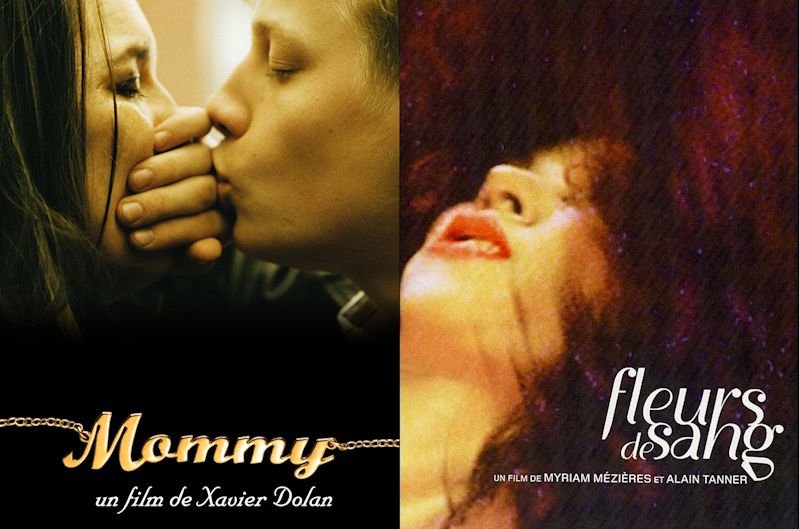
The dichotomy between the "madonna and the whore"—between the woman one loves and the woman one desires—and the difficulty of reconciling them into one, was an expression coined by Freud that gained currency to denote a certain schizoid ambivalence inherited from the Oedipus complex in some men (Freud wondered if it were all men) in their relationships with women. This dichotomy was later reformulated by Lacan in terms of jouissance and the law: the idealized woman of incestuous jouissance (the mother), who conflicts with infantile narcissism and establishes the incestuous prohibition (the Superego) as a protection, versus the sexualized woman of phallic jouissance (the whore), who appears when desire is structured through the law of the "Name-of-the-Father," resulting in symbolic castration and the lack-in-being.
However, it is not this specific meaning I wish to highlight here, but rather the destructive interrelation established between love and jouissance when not mediated by the law. I explore this through two excellent films that masterfully describe the difficult, impossible relationship between a mother who is fascinating and wonderful, yet annihilating and terrifying in her maternal role, in the absence of the father. They do so from two very different perspectives: the "son of a whore"* as an object who ravages the mother (Mommy, Xavier Dolan, 2014), and the "whore"* as a subject who ravages the daughter (Fleurs de sang, Myriam Mézières, 2002).
Mommy
Mommy begins with Diane—the mother—picking up her son, Steve, after his expulsion from the psychiatric institution where he was interned for misconduct. She chooses to take him home and care for him herself, rather than have him committed to a bleak public psychiatric facility with a semi-penitentiary regime.
From this initial moment, Steve’s disturbing behavior begins to reveal an ambivalent, highly eroticized, and violent relationship between them, a consequence of the absence of a paternal function—the Name-of-the-Father—to act as a law capable of operating a separation: "to mediate the distance between the identification with the ego ideal and the identification with the mother's desire" (Lacan). The son remains the cause of the mother’s jouissance, placed in the position of a fetish linked to maternal phallic satisfaction—the "object of the mother whose function is to reveal the truth of this object" (Lacan).
From this position, however, the son does not respond to his pathology passively, but with a clearly perverse edge that oscillates between love and hate, eroticism and violence, demand and drive, Steve’s incestuous desire and death drive—Diane’s jouissance and fear. It is a dual, exclusive relationship, sealed off from the rest of the world—from the Father and the Law—which also triggers in Steve an extreme violence toward any man who approaches his mother, any man who sexualizes her.
This annihilating maternal-filial relationship is attempted to be rechanneled by incorporating Kyla, a melancholic neighbour who agrees to join the game, allowing and accepting the obscene and destructive dance between them. They form a kind of trio, as if it were an attempt at mutual therapy capable of saving the relationship, yet it fails—for Kyla is not the law, nor the cure for Steve.
Ultimately, the mother, overwhelmed by the lack of the inscription of the Name-of-the-Father in Steve, turns to judicial law—Steve's internment in a psychiatric hospital—accepting that, sometimes, love does not save.
Fleurs de Sang
Fleurs de sang (Flowers of Blood) tells the story of Pam, a fourteen-year-old girl who has escaped from a foster home to reunite with her mother, Lily, who is destitute and prey to her own helplessness and self-destructive tendencies.
Pam, who does not know who her father is and has never set foot in a school, recalls the misfortunes of her life alongside her mother—an erotic dancer—traversed by the pain of loneliness and lack of love. She recounts her struggle to survive in a sordid, selfish, and cruel world, and how her intense curiosity led her to become self-taught, becoming her mother’s protector at just nine years old.
Here, we see a woman overwhelmed by her circumstances. Despite the love she professes for her daughter, she negligently neglects her maternal function, which is delegated to the daughter due to Lily’s imperative economic need and her desperate need to be loved. The absence of an emotional and sexual partner manifests through the sexual and economic exploitation she is subjected to—her humiliation and bitterness—as she places herself in a role of jouissance as a mere erotic object before an audience that demands her nudity and public exhibition, and before casual lovers incapable of transcending their own "idiotic" (phallic) jouissance, finding no help, friendship, love, or stable work along the way.
Due to the neglect of her daughter (then nine years old), the Juvenile Court removes Lily’s custody, condemning her to a descent into hell that leads to self-destruction and homelessness.
After five years in a juvenile centre, Pam begins to visit and see her mother again. She meets a young photographer in whom she deposits the unbearable void produced by the abandonment of the maternal function, turning him into the obsessive object of her repressed and rejected need for love and protection. However, when he senses who she is and what she represents to this girl—stripped of everything, trapped in a maternal jouissance not mediated by any law—he feels panic and proposes separation. This is something she cannot bear, and she ends up killing him accidentally, gripped by horror and despair in the face of the terror of confronting and recognizing her own desire as the process of individuation begins.
* "Son of a whore" and "Whore" are not used as insults, but in their metaphorical meaning in the text
Accessed 1 times