
The truth shall set you free… and so will love.
Perhaps because I was very young when I saw it, perhaps due to the beautiful and passionate music of Georges Delerue —although this prolific composer has hundreds of wonderful scores (and I am not exaggerating)— or perhaps because from beginning to end the story drags the viewer into a vortex of raw emotions that offers no respite, "L'important c'est d'aimer" (The Important Thing Is to Love), a film by Polish director Andrzej Żuławski released in 1975, is one of those I always remember with the greatest emotion.
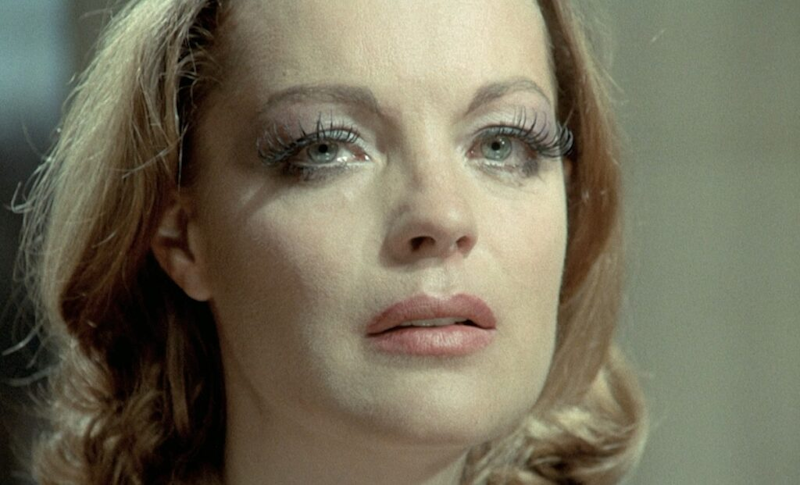
The plot, adapted from Christopher Frank's novel "La Nuit Américaine" (The American Night) —who also co-wrote the film's screenplay alongside its director— follows the story of Servais (Fabio Testi), a photographer who works for a Parisian mobster (Claude Dauphin) photographing clandestine pornographic scenes and orgies involving influential individuals for subsequent blackmail. After sneaking onto a film set as a freelancer, he takes clandestine photos of Nadine (Romy Schneider), a washed-up actress working in B-movies just to survive.
From the very moment he sees her, Servais —the photographer— will be possessed by an uncontrollable desire to save her from her economic and emotional misery, perhaps hoping to save himself in the process as well. He will experience this in the form of an irresistible love to which Nadine, trapped in her own suffering and the toxic, destructive relationship she maintains with her husband Jacques (Jacques Dutronc), will not know how to respond.
Desperate to help her succeed as an actress again —feeling it is the only thing that can save her from herself— Servais borrows money from the sinister mafia boss he works for. His intention is to secretly finance, through the actor Karl-Heinz Zimmer (Klaus Kinski), a play in which Nadine will star.
This relatively simple plot, under Żuławski's histrionic gaze, transforms into an intense exploration of the limits of love, desire, and anguish in the face of loneliness, suffering, and lack. Here, love vainly attempts to suture the gap between fragmented and vulnerable individuals who are unable to find each other, living their trauma in a tragic and intense manner —something manifested through their bodies and overflowing passions.
Through a decadent aesthetic and a delirious distortion of reality —a parade of characters continuously overwhelmed by their anxiety and despair— the screen becomes a close-up of the tormented world of these creatures on the edge of the abyss who populate its scenes, trapped in labyrinths that lead nowhere. It is through their histrionic performances and surreal sets that the camera manages to distance itself from any objective reality, transforming into a record of the characters' inner worlds, their feelings and passions, their fury, their pain, and their hope, turning the screen into a stage that directly appeals to the viewer's soul, deeply moving them emotionally.
It is in the midst of this immense ocean of anguish and decadence in which all its characters float that the camera rises once again to portray, with unusual vehemence, the birth of a tense, immediate, and overwhelming love. It shines above the reigning darkness and decay like an irresistible passion —inexplicable to characters who can only surrender blindly and ecstatically to its virulence— as the ultimate redemption of the human soul, capable of providing hope against the darkness and degradation of the world around them.
If the environment has stripped the characters of their dignity and happiness, love is the only thing that can restore them and allow them to find themselves once more through each other.
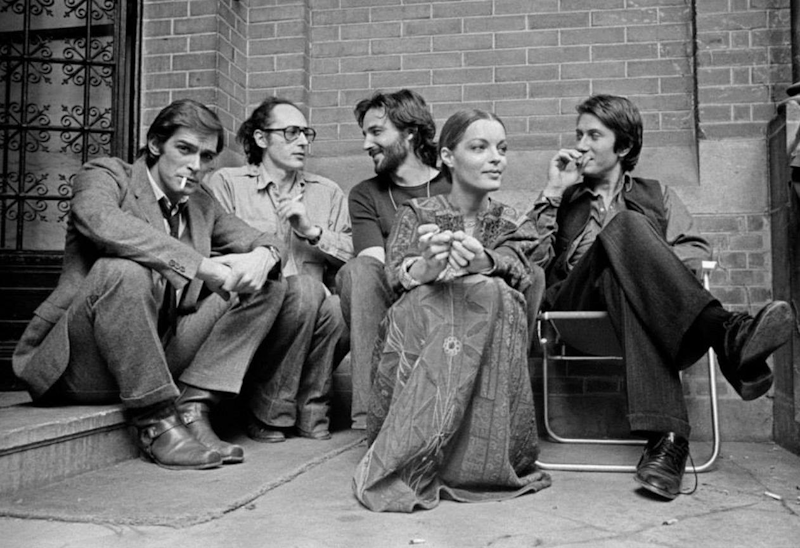
Fabio Testi, Christopher Frank, Andrzej Żuławski, Romy Schneider, and Jacques Dutronc during the filming of the movie.
Accessed 1 times