
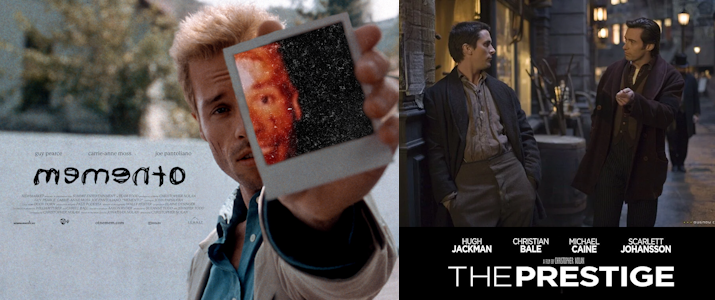
Christopher Nolan is a film director who deeply interested me in his early days. I felt that, hidden beneath his films, he was covertly asking himself a question that I, too, had been pondering since adolescence: "If the truth could ever be known, should it be sought in the details?"
I do not know if, as a child, he was a fan of Sherlock Holmes, who also seeks the truth behind the details. But clearly, the Holmesian method—exhaustively exploring clues to reach a precise diagnosis and solve the case—does not work for Nolan. Holmes, like his creator Conan Doyle (a physician, much like his character Watson), transfers deductive methods based on the observation and assessment of symptoms from the realm of medical diagnosis to that of criminal mysteries. Like a doctor, Holmes strives in his investigations to formulate a hypothesis that, starting from the observation of apparently incomprehensible facts, establishes a causal nexus to explain them; from there, he uses deduction to extract the necessary consequences of the proposed hypothesis. Finally, through an inductive process, he tests those deduced consequences. If the hypothesis is confirmed, it is revealed as true; if not, he formulates a new one until he finds the correct one and solves the mystery.
In a way, Holmes uses the scientific method, relying on the observation of signals irrelevant to the eyes of the profane to reach a diagnosis—a revelation of what remains inaccessible to direct observation. This is what so excites the scientific investigator, and also what so frustrates them, as it often remains unrevealed, hiding beneath inescapable, uncontrollable variables that are invisible even to someone like Holmes.
The scientific method in crime-solving ceased to function—at least in fictional narrative—after Holmes. His descendants—investigators like Sam Spade or Philip Marlowe—suddenly collided with film noir, where the plot dragged them in as mere pieces on a board, in a game whose moves must always be made from the shadows. The same fate eventually befell some scientists, such as physicists when they encountered the Heisenberg uncertainty principle and the unexpected dependence of the observer (or measurer), trapping them involuntarily as part of the obtained results. This is precisely what happened to Nolan when he launched himself into interstellar space and time travel in his incessant epistemological and metaphysical search.
But returning to Nolan’s beginnings, it seems he wanted to show, from his own perspective, something that many others had already intuited—such as the philosophers of deconstruction (Derrida, Foucault) or the psychoanalysts themselves (Freud, Lacan), for whom the truth returns to the subject by way of the symptom*.
* * In its psychoanalytic conceptualization, the symptom contains a truth that the subject does not know and that is imposed upon them in a pathological disguise. It presents a subject divided between their knowledge and their truth—an opaque truth that pushes them to act against their own well-being and to feel divided against themselves, for while they may feel satisfied and complete with their knowledge, they also suffer from the truth that the symptom embodies.
Memento
Truth Masked as the Symptom of a Neurological Disease
In Memento (2000), the protagonist suffers from anterograde amnesia, a disorder that prevents him from forming new long-term memories after suffering a traumatic event in a violent episode that also resulted in his wife's death. This launches him into a frantic search to find and kill her murderer.
His condition reveals the protagonist's inability to construct a coherent narrative about his own life, and how the absence of long-term memory profoundly impacts the subjective perception of reality, the formation of identity, and the ability to trust oneself and others—leading to a permanent state of paranoia and distrust, intensifying the sensation of isolation and despair.
Having lost the ability to form new memories, the protagonist clings to his pre-traumatic identity—that which he still remembers and has turned into his mission, the memory of his wife and his quest for vengeance—to give a sense of purpose and continuity to a life and a world that now, unable to use his memory to articulate them into a coherent narrative, appear continuously fragmented. This poses a constant challenge, making him feel extremely vulnerable and plunged into deep disorientation due to his inability to discern truth from lies.
These initial memories, however, eventually reveal themselves to be false, displaced, and condensed—much like in dreams. They are projected onto a former client who killed his wife by administering an insulin overdose because he could not remember having administered previous doses—a false memory, displaced onto a spectre of himself, the one who actually killed his own wife because he could not remember.
This process suggests that the absence of memory could also be due to the repression of a traumatic event in the unconscious—the murder of his own wife, to whom he has now consecrated his life in vengeance—and the guilt he experiences regarding this repressed event. This is rationalized through the displacement of himself onto the character of the insurance agent who refused to believe the client, considering him a mere vulgar faker; it is his own emerging guilt, stemming from the repressed content.
The great appeal of this film lies in its non-linear narrative structure, continuously alternating two types of sequences: those in black and white, which advance chronologically, reflecting the protagonist’s normal perception of reality before his traumatic condition; and those in color, presented as fragments in reverse chronological order. This prevents the spectator—who is ignorant of the past—from using their own memory to articulate them, forcing them to experience the confusion and uncertainty that the protagonist suffers constantly in a reality that is, for him, fragmented and devoid of a past.
Without long-term memory, the protagonist is condemned to live only in the present—an eternal present where time exists only as a minimal, fragmented instant. The absence of the flow of time—the necessary space that, in its transit, forms the illusion of continuity in consciousness—causes the world to appear in all its rawness as it is: an infinitely fragmented reality devoid of meaning. It is a reality in which the sick protagonist, without memory (the Alzheimer’s patient), immerses himself without any defenses, failing miserably in his attempt to articulate a coherent, non-fragmented internal reality.
This truth—this fragmented reality—which also has an internal version, since the unconscious immerses itself similarly in the world without memory and will find itself equally trapped in an eternal present, becomes intertwined in psychoanalysis in the form of a compulsion to repeat in the symptom (Freud) and also in "jouissance" (Lacan) within the subject’s conscious psychic narrative, restricting the truth to remain hidden from the subject and manifest only in the detail—the symptom or the "jouissance of the symptom": the bodily tattoos and the Polaroid photographs that the protagonist overwrites, trying to retain minuscule fragments of the truth, which later, outside of their original (repressed) context, only serve to deceive and confuse him further—much like the symptom does.
The Prestige
Truth Masked as a "Miracle" or Enigma in a Magic Trick
The Prestige (2006) tells the story of the rivalry between two famous magicians and their obsession with outdoing one another. This leads them to inconceivable extremes, mixing loves, murders, and even Nikola Tesla and teleportation. They are seeking what—in the words of the entrepreneur who creates many of their tricks at the beginning—is the prestige:
"Every magic trick is divided into three parts, or acts. The first part is 'The Pledge': the magician shows you something ordinary: a deck of cards, a bird, or a person. He shows you this object. Perhaps he asks you to inspect it to see if it is indeed real, or unaltered, or normal. But of course... it probably isn't. The second act is 'The Turn': the magician takes the ordinary something and makes it do something extraordinary. Now you're looking for the secret... but you won't find it, because of course, you're not really looking. You don't want to know. You want to be fooled. But you wouldn't clap yet. Because making something disappear isn't enough; you have to bring it back. That's why every magic trick has a third act, the hardest part, the part we call 'The Prestige.'"
The film shows that behind the prestigious enigma contained in the magic trick—behind the "miracle"—lies an enormous sacrifice, a vital choice required only to reach that brief moment of greatness. This is something that remains inconceivable to the spectator, and that is precisely where the magic trick resides: in the spectator's inability to conceive that such an excessive and colossal sacrifice has been made just to obtain a brief moment of glory. Thus, it is revealed that to succeed with his teleportation trick, one of the magicians has hidden the fact that he was never one, but two—identical twin brothers alternating successively under the identity of a single magician—who destroy their lives and romantic relationships along the way because of the constant pretense. Similarly—and making an even greater sacrifice—the other magician, obsessed with outdoing him in his teleportation act, has ended up possessing, thanks to Tesla's genius, a fantastic contraption capable of replicating himself. He has preferred to let the copy (or the original, it is unclear) die and hide it after each performance—rather than show the device to the world—only to enjoy the prestige after having performed what he considers the definitive act.
In a way, Nolan insists here again that the truth lies hidden behind the detail—the "apparent miracle"—but it turns out to be so inconceivable that no one can accept it. Only certain exceptional beings, from their special sensitivity, will be capable of intuiting it, such as the small child who cannot contain his weeping after having witnessed a magic show. The magician appears with a small bird trapped in a cage, covers it with a cloth, and waves his magic wand, leaving all those present astonished when he removes the cloth and they observe that the little bird has magically left its cage and is in the palm of his hand, flying freely through the room. His mother tries to comfort him and make him understand that the bird has been magically transported from inside the cage to the magician’s hand and is now happier because it can fly in freedom, but he continues to weep, answering that he is not crying for that bird, but for the one that had to be crushed to death at the bottom of the cage.
Accessed 102 times