
Many years later, facing his service weapon during the fateful night he took his own life, Sergeant Antonio García of the Civil Guard was to remember that remote afternoon when his father took him to witness the miracle of Macondo del Caudillo—at that time a village of barely a dozen houses scattered among vast wheat fields and lush forests of centuries-old holm oaks.
That year, after setting up their camp beside the village, a group of ragged circus gypsies announced to everyone, amid a great uproar of whistles and drums, that for a modest sum—barely a pittance—all the locals who witnessed their fabulous show after sunset on the first night of the full moon would magically see their harvest tripled and their sick relatives miraculously healed before their very eyes.
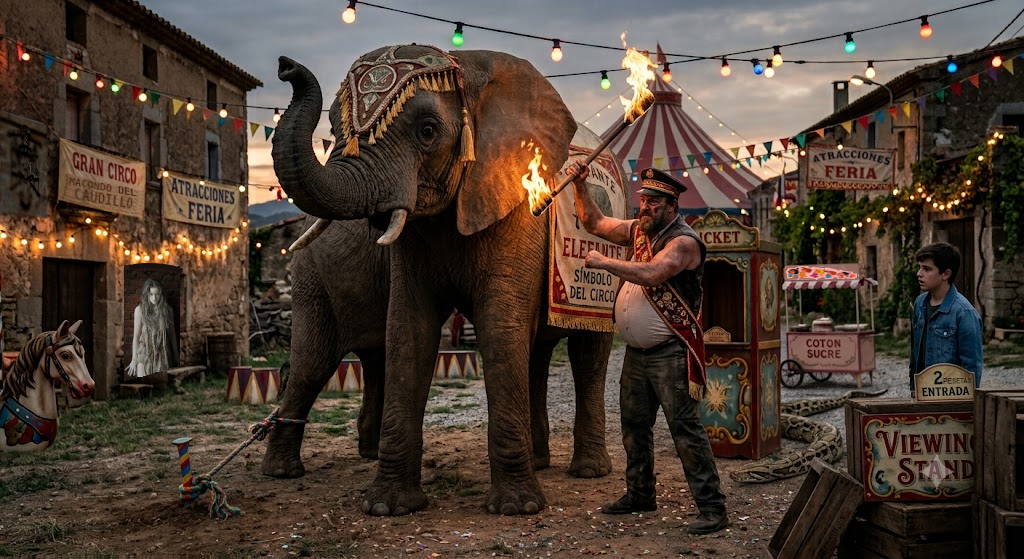
Every single villager without exception, eager to be historical witnesses to that miraculous event, gathered alongside farmers and shepherds who had travelled from remote farms. Following an endless succession of acrobatic dances and strange chants by the light of a massive bonfire, a burly gypsy of gloomy appearance and thick beard, who called himself Melquíades, appeared before them dressed in exotic garments, mounted atop a huge elephant. That fearsome wild animal knelt before everyone like a lapdog at the gypsy's command; and responding to the weeping and pleas of a desperate woman, Melquíades dismounted, approaching with a majestic stride the feet of a crippled, ragged girl lying on a rickety wooden and cane cart in which her mother had brought her to the camp.
After asking her name, he placed both hands firmly on her face and, raising his eyes toward the starry sky, the gypsy ordered in a thundering voice that, in the name of the supernatural powers granted to him in life, that poor crippled creature stand up and begin to walk on her own without any help. At that moment, the full moon shone intensely on the horizon, spilling over the dark night, and radiated with its light the helpless body of the girl, who began to glow, walking clumsily as if she were a strange, hypnotic vision from which that same whitish light emanated for a few moments. A faint, cold light that seemed to enfold them both under its spell, like a wretched reflection of another distant light that everyone greedily and secretly yearned for in their darkness.
José Alfonso García, who had never believed in miracles or magic—having been informed by an official dispatch the previous week from provincial headquarters about the danger and dark arts of those vagrants and troublemakers roaming the region—proceeded immediately to arrest him in the name of law and order. Once the show had concluded, he locked the gypsy Melquíades alongside the mother of that scrawny girl who pretended to be an invalid in the holding cell until receiving further orders from his superiors.
The sergeant, who was a child back then and had not yet joined the force, dutifully and proudly helped his father with their first joint arrest. The following morning, while his father tried in vain to make the mother and the gypsy confess all their deceptions and trickery before the law, Antonio, eager to please him, took it upon himself to guard the camp, where that brat—a precocious apprentice swindler—remained lying in her cart after refusing to walk again.
"Get up and walk to the holding cell if you want my father to let your mother go!" he began shouting at her, while she stared at him in fear without saying a word, as if she also refused to speak. "Get up and start walking!"
After spending a long time sitting in silence across from her beneath the indifference of the gypsies and the scorching midday sun, he felt thirsty and exhausted, and decided to head back home. He turned around and began walking with his head down, without looking back or saying anything, until, after passing a small patch of bushes, he suddenly heard the disturbing hiss of a viper lurking there. Without a second thought, he picked up a wooden stake lying on the path beside him and trapped the snake with it, which began to coil sinuously around the far end.
"Get up and walk if you don't want me to throw this snake on top of you!" he shouted again, approaching the girl and threatening her with the horrible beast.
Suddenly, a terrible shriek of pain echoed throughout the camp, and he watched in horror as the snake quickly slithered away after lunging at her, gliding silently over her haggard, whitish skin. Antonio began to run in terror and did not stop until he reached home, locking himself in his room; yet that atrocious scream amid the terrifying hiss of death refused to stop drilling into his brain. When darkness fell, giving way to panic, he ran out again—this time toward the cell where the gypsy was locked up—intending to beg him, against his father's solid beliefs and his own, to perform a new miracle and bring that wretched crippled girl back to life.
Unfortunately, the girl's lifeless body, still lying in her cart, startled him upon reaching the door. He heard his father, surrounded by several villagers, saying that the gypsy had confessed to being the girl's father and to having used her to spread his lies, meaning the responsibility for her fatal death also fell upon him and his negligent conduct.
"What are you doing here at this hour?" his father shouted furiously, looking at him as he noticed his presence.
"I came looking for you," Antonio lied, terrified.
"Go back home and tell your mother not to wait for me for dinner tonight, because I'm waiting for the patrol that's going to take these criminals to the provincial prison," he said, covering the girl's lifeless body with a dark blanket.
Antonio returned home and never spoke to his father or anyone else about that tragic incident again. But that night he suffered a terrible nightmare in which he dreamt that the girl was alive once more and was coming to find him to show him something he had to see. She had a sweet voice and walked gracefully, taking small hops ahead of him, so in his dream Antonio felt happy. But a few moments later, in the middle of the darkness surrounding them, there appeared the fearsome silhouette of the gypsy, furiously brandishing the very same stick around which the snake had coiled, wrapped in fire, standing over the front legs of that massive elephant, ordering it to kneel again.
"Why doesn't it rebel?" Antonio shouted so she could hear him over the terrible shrieks of pain from that huge animal.
"It can't," the girl replied, pointing to a wooden stake driven into the ground, tied by a rope to one of the elephant's hind legs.
"Of course it can!" he retorted, enraged by that abominable scene of abuse. "The problem is it doesn't even try!"
"It already tried when it first arrived, the first night it was tied up," she said, looking at him. "And it ended up suffering horrible wounds that kept it bedridden with pain for several days."
"That's impossible," he insisted. "It could give a single yank and, with its strength, free itself from its chain without the slightest effort."
"I already told you it couldn't free itself," she said. "Back then, it was just a baby elephant."
"But now it's a fearsome and immense animal!" he protested.
"But it doesn't know that," she whispered softly, as if afraid that poor animal might ever discover the nonsensical secret that kept it chained to its wretched life of obedience and suffering.
"Why did you bring me here?" he asked, annoyed by the malice of those Machiavellian gypsies. "Did they chain you up too so you wouldn't learn to walk?"
"No," she said, her voice seeming to fade into the dream like an echo through the mist. "Tying us up like elephants doesn't work on children."
"Then what did they do to you?" he asked again.
"Why do you insist on denying what your own eyes have shown you?" the gypsy suddenly roared with his thundering voice upon noticing his presence.
"Because what you call miracles are nothing but lies!" Antonio shouted, gathering courage in the dream.
"A lie, perhaps," the gypsy replied, raising the burning stick menacingly before him, "but the only lie we wish to believe when the truth is too insane and abominable for us to even dare look at it."
Suddenly he opened his eyes in terror and realized he was still in his room. He was drenched in sweat, and try as he might, he could not fall asleep again.
He never learned anything more of the fate of Melquíades, the girl's mother, or the rest of the camp, nor did he ever do anything to find out. Only occasionally, on certain grey and rainy days when he felt sad and somewhat depressed, he would walk to the old cemetery and sit in silence on the wet grass in front of a small, nameless headstone, thinking of nothing or passing the time building a flimsy wooden cross out of dry twigs that he would later leave forgotten there—though soon that, too, came to an end. Antonio moved on with his life and more than fulfilled everything destiny had reserved for him, eventually amassing a distinguished record of service as meritorious and praiseworthy as that of his father, who died a few years later in the line of duty.
Yet from that night onward, Antonio began to show a certain weakness of character that unfortunately worsened over time, progressively clouding his reasoning until finally leading him to the fateful night of his suicide. Subtle, isolated signs of some affliction or frailty that never interfered with his just and upright conduct or his faultless service record, but which unjustly remained like tiny blemishes tarnishing some of his most heroic acts. Like that occasion when, after valiantly putting down a violent insurrection of anarchist miners in the north, he was awarded the medal for valour alongside his brigade mates; and in the middle of the solemn ceremony, he fell victim to some sort of unfortunate trance that led him to break protocol and stumble clumsily toward the presidential dais—filled with captains and other high military commanders and authorities—brandishing his service weapon and asking why they were honouring him with such a distinction merely for having turned into a ruthless killer. Or that other time when, in a fit of insanity, he began shouting before everyone in church, claiming he was none other than the devil himself, and tried to set fire to the chapel while the parish priest was officiating the funeral of a young union worker who had died accidentally during an interrogation at his barracks while he was present—an interrogation that would ultimately result in the dismantling of one of the most major criminal syndicates that had plagued the province.
Anecdotal events that fortunately did not prevent him from being buried with honours beside his father's grave, but which, like his suicide, always remained incomprehensible to his family and acquaintances. Isolated episodes that, much like the miracle he himself had witnessed the gypsies perform during his childhood, would remain forever unanswered and unexplained in everyone's mind—as testimonies to the existence of mysterious forces and afflictions that escape the logic of reason and the daily reality of life; enigmas of other realities showing that, as Hamlet, the Danish prince, once said, there are more things in heaven and earth than are dreamt of in human knowledge.
Accessed 102 times