"Here I am, Leopoldo María Panero, son of a drunken father and brother of a suicide, pursued by birds and memories that lie in wait for me every morning, hidden in the brush, screaming for memory to end and for the recollection to turn blue, and to moan as I pray to nothingness to die."
Poem by Leopoldo María Panero
While not strictly a "film" in the conventional sense, but rather a documentary, The Disenchantment (El desencanto, 1976) is, in my opinion, along with The Spirit of the Beehive, one of the great cinematic documents for understanding the Spain of the late Franco era. By its very nature, it transcends that scope entirely.
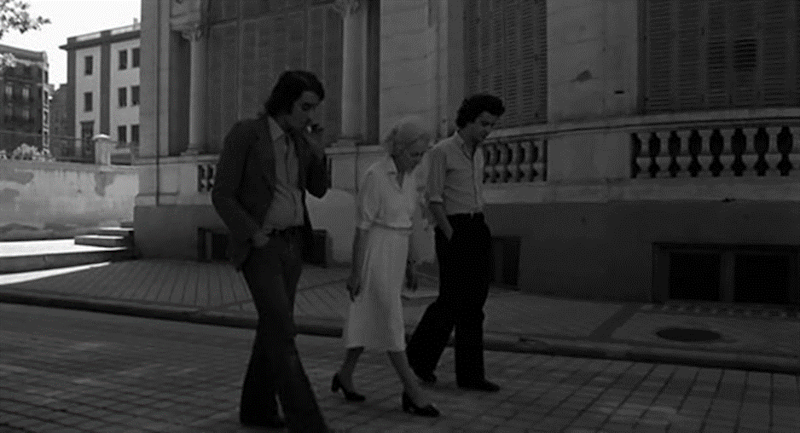
On the surface, The Disenchantment is merely a dialogue between the widow and the three sons of the regime's poet, Leopoldo Panero. It centers on the omnipresent void left by the dead poet—a veiled stone statue, never actually seen—which the family intends to erect in his hometown square of Astorga.
In a sense, the film is nothing more than a dialogue among a very peculiar, literary family revolving around the metaphor of the dead father: the authoritarian, omnipresent figure whose death his children desire—whether consciously or not—but whose shadow will continue to dictate their destinies throughout their lives. Furthermore, the film's release one year after Franco's death caused it to transcend the strictly domestic sphere and enter the social realm. It became a metaphor for Spanish society following the dictator's death and the "disenchantment" of the Transition—a period that, far from being a liberation, revealed what the dictator’s figure had previously obscured. It has been aptly said that if The Disenchantment was the metaphor for Francoism, After So Many Years (Después de tantos años)—a new documentary on the same family made by Ricardo Franco nearly twenty years later, in 1994—became the metaphor for the Transition (Túa Blesa, Professor of Literary Theory and Comparative Literature at the University of Zaragoza).
The director, Jaime Chávarri, stated that the intention behind this project was to convey that "the power of the family is equal to the power of the State, or any other. There comes a moment when you must rebel against that tyranny." Leopoldo María, the middle son and undoubtedly the most compelling of the three, immediately retorted: "I do not believe in family epics, because no one is going to tell the truth."
The mother, Felicidad Blanc—a writer and friend of poets Luis Rosales and Luis Cernuda—was a well-to-do girl from Madrid, daughter of a doctor who was a first cousin to the mother of Josemaría Escrivá de Balaguer (founder of Opus Dei). She would say she fell in love with the poet upon reading a love poem in which he called her beautiful. The youngest son, Michi, describes her as a woman who lived subjugated to family whims and shouting, like a Victorian piece of furniture—quiet, discreet, and subservient—or, in the words of the poet Arthur Rimbaud, "Par délicatesse, j’ai perdu ma vie" (Out of delicacy, I have lost my life).
The eldest brother, Juan Luis Panero—also a poet and an alcoholic—essentially presents himself as an imitation of a novelistic character, maintaining a distant, ambivalent relationship with his father and a conflicting, love-hate relationship with his middle brother, Leopoldo María.
José Moisés Panero (Michi), the youngest brother—a future night owl, partygoer, womanizer, and an alcoholic like his father and brothers; a writer without a body of work and author of unpublished stories—is, in this film, still so young that he seems to wander among the others with a certain bitterness for not yet being anyone of importance in such an illustrious family. He is a man whom the writer Vila-Matas would describe as someone who dreams of "ceasing to be a poor child out of a Dickens story, marrying an heiress like Barbara Hutton, divorcing her quickly, and, of course, never having to write."
Leopoldo María Panero—the middle brother, the poet of darkness and desolation, but also the bohemian, the leftist radical who would spend time in prison, the alcoholic, the heroin addict, and the diagnosed schizophrenic who attempted suicide several times and would eventually die in a psychiatric hospital—is the one who articulates the raw, painful word: the real behind the pantomime, the truth behind the epic legend (Lacan), and the failure of the word to bypass madness. For him, madness in his poetry becomes a form of lucidity in the face of death and pain ("In childhood, one lives; afterwards, one survives").
In a way, while Juan Luis became the substitute for the living father for their mother after the patriarch's death, Leopoldo María became the substitute for the dead father—the target of the mother's constant complaints regarding the void left by her husband's passing—while Michi became the one trying to understand, explain, and redeem her.
Eighteen years later, in 1994, director Ricardo Franco filmed After So Many Years, a sequel to The Disenchantment in which he brings the three brothers together again (the mother having since passed away) to recount how their lives have unfolded since the first film appeared.
Accessed 1 times