
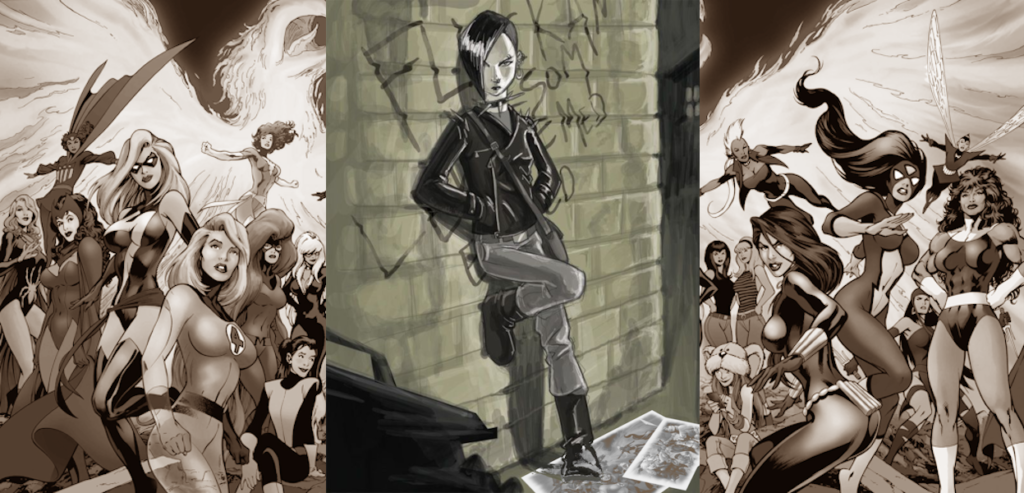
Some literary characters seem to become a symptomatic expression of a masculine fantasy from one perspective, and a feminine one from another; this could be the case with Lisbeth Salander.
Following a childhood marked by extreme domestic violence and systemic institutional neglect, Lisbeth, who grew up witnessing her father brutally beating her mother on a constant basis, accumulated a deep resentment and a strong sense of justice against abusers. This entire family hell culminated in a traumatic event at the age of twelve—when, after witnessing a beating that left her mother with permanent brain damage, Lisbeth launched a homemade Molotov cocktail at her father's car while he was inside, causing him severe burns and permanent scars. Following this violent event, she was declared a danger to herself and others and confined to a psychiatric clinic for adolescents, where she encountered a psychiatrist who was merely a re-edition of her father, inflicting all kinds of punishments and humiliations upon her with the object of breaking her.
At the beginning of psychic life, there are no differences between boys and girls; both share the same interest in the mother. The so-called castration complex will allow the girl to exit that relationship, pushing her to seek in the father the object that—like the mother—has been vetoed for her, the object one envies possessing—the phallus—, something her twin sister, Camilla, will do, trying to ingratiate herself with her father or ignore the abuse, but which Lisbeth cannot do, as she will dedicate herself to being the phallus.
Lisbeth’s true vocation will then be to make herself desired; in her effort to capture the gaze of the Other's desire, she will turn her body into a surface of inscription—tattoos, piercings—, increasingly aggressive attire, a changing look offered to the obscene gaze of the Other, feeling her own body as something increasingly alien, like a huntress who, seeking to hunt the desire of the Other, risks being hunted herself.
Lisbeth therefore becomes the compass of desire, the one who makes desire circulate, trapping the reader (male and female alike) in the plot of the story; she is the phallic fantasy of Artificial Intelligence, the incredible hacker, academically orphaned in a postmodern world where the master—the bearer of the phallus—has already been dethroned. If Lisbeth, like a good hysteric, shows the naked and obscene truth of those who, like her father, propose themselves as feudal masters—those who do not love women but only desire them as trophies to display under their dominion—and ends up establishing herself—the former victim—as a modern vigilante, she also, as a good postmodern hysteric, screams at the academic master that his knowledge is not the truth that matters, that she possesses a more real and dark knowledge, the knowledge born from the fantasy of the child aspiring to be a tech guru who dreamed of having superpowers—the power of technological knowledge in an increasingly robotized world—, the knowledge she will not hesitate to use to bring the truth to the surface.
To feel like the phallus—to make herself desired—, Lisbeth must provoke lack in the other, make their lack appear—their castration—, their hidden lie that will help destroy by bringing out the truth, the truth of the master who does not know he is castrated. She must propose herself as an object for the Other’s lack, in such a way that desire can be kept alive, that is, unsatisfied. It is in the lack of the Other that she will find her being; from here will arise her aggressiveness toward those who do not show their lack, and also her tenderness toward those who, like Mikael Blomkvist, seek the truth that the master hides from his honesty and his humble position, who cannot help but show his castration.
Thus, despite her antisocial behavior, her “belle indifférence,” her vital dissatisfaction, turned into an active hatred against an unjust, hypocritical, and predatory world, she is someone willing to help him, she is someone with the vocation of a helper, of a "secretary" in the background; she is the one who will always be "there where needed," the phallic prosthesis that the Other does not know he needs.
In Mikael Blomkvist—the man who has renounced the phallus—, who no longer seeks it against the truth, who knows (or not) that we are all castrated, Lisbeth will find the man of her dreams, the man who loves her as she longs to be loved, not as the simulated phallus he pretends to be, but as what she is: the pain of the lack in being, as someone who was unjustly deprived of what she lacks and still hopes to receive, as someone also capable of loving, of “giving what one does not have to one who is not.”
Lisbeth Salander is one of the characters in the novel The Girl with the Dragon Tattoo (2005), which belongs to the Millennium series, written by the Swedish journalist and writer Stieg Larsson.
Accessed 1 times